
Does a dehumidifier help with mold in Florida?
Short answer
Yes, for prevention. A dehumidifier helps keep indoor humidity below 60 percent, which the Florida Department of Health recommends to prevent mold, and it's useful in closets, seasonal homes and after water damage. It won't remove mold that's already growing, or the mycotoxins it leaves. And if a home with central AC needs one to stay under 60 percent, the AC should be checked.
What a dehumidifier does, and doesn’t do
Mold needs moisture. A dehumidifier takes water out of the air, which lowers relative humidity and dries out surfaces over time. Public health guidance treats it as one of the two main tools for that job: the Florida Department of Health, the CDC and the EPA all recommend an air conditioner or a dehumidifier to keep indoor humidity down.
| A dehumidifier can | A dehumidifier can’t |
|---|---|
| Keep humidity below 60 percent in a room or small area | Kill or remove mold that’s already growing |
| Slow new growth on walls, contents and closets | Remove spores, fragments and mycotoxins already settled in dust |
| Help dry a space after a leak or flood | Dry the inside of a wet wall or soaked drywall on its own |
| Protect a closed-up seasonal home | Fix the AC problem or leak that caused the moisture |
Our national page on whether dehumidifiers reduce mycotoxins explains why drying the air doesn’t clean up toxins that are already there.
Where dehumidifiers earn their keep in Florida
Closets and problem rooms
Walk-in closets, laundry rooms and bedrooms on exterior block walls often run damper than the rest of the house, because conditioned air doesn’t reach them well. A small unit in one of those spaces can make a real difference. The Florida Solar Energy Center also suggests simply leaving closet doors open so more conditioned air reaches them, which costs nothing and is worth trying first.
Seasonal homes
The Florida Solar Energy Center describes running a dehumidifier on a timer for a few hours a day as one way to protect a vacant Florida home. It works best alongside a working AC system, not in place of one. Set it to drain continuously into a sink or floor drain so it doesn’t shut off when the bucket fills. Our page on whether to leave the AC on when you leave covers the rest.
After water damage or a storm
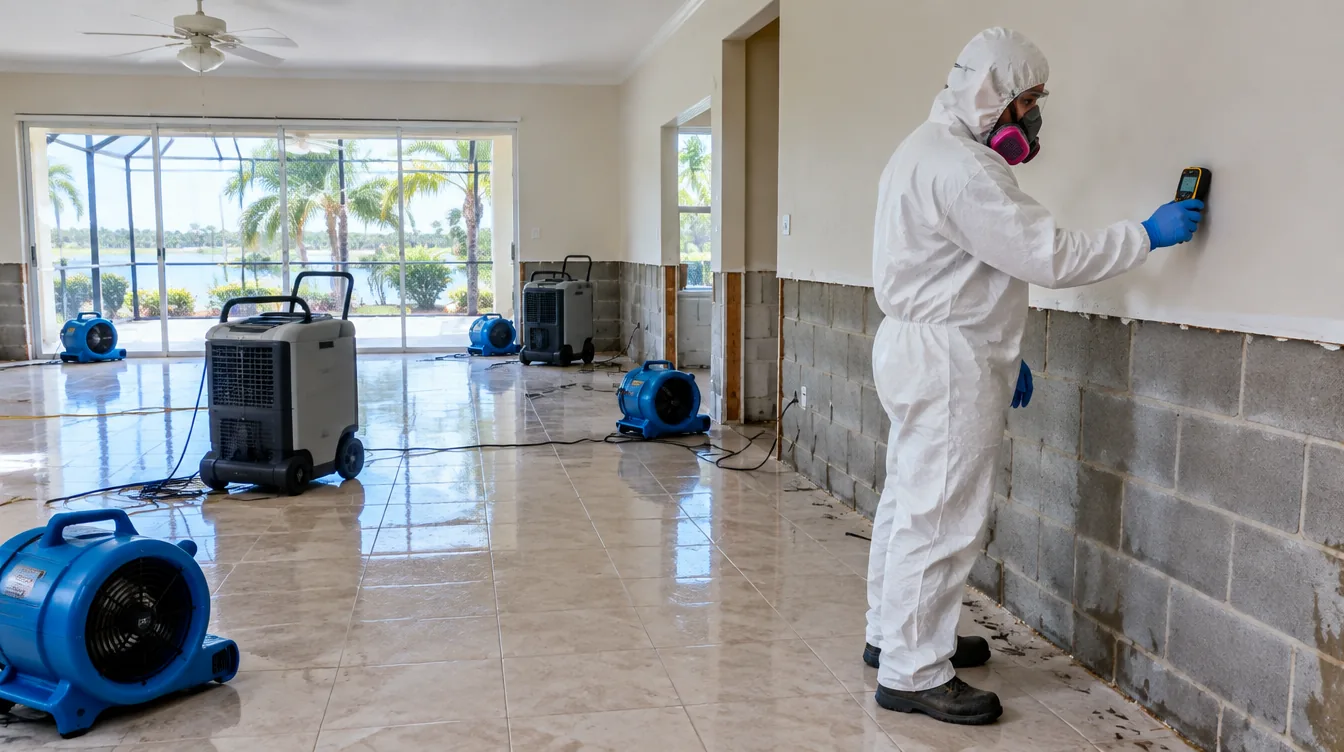
The EPA and CDC advise drying water-damaged areas within 24 to 48 hours. After a hurricane, when power returns, dehumidifiers are one of the fastest ways to start. A household unit can help in a single room. Drying a flooded house, including the block walls and slab, takes commercial dehumidifiers and air movers, with moisture readings to confirm the materials are actually dry.
When needing a dehumidifier is a warning sign
Here’s the Florida-specific point most people miss. The Florida Department of Health says that if you have central air conditioning and still need a dehumidifier to get relative humidity below 60 percent, the AC system should be examined for problems. A healthy, correctly sized system should control humidity in most Florida homes on its own. Common culprits include an oversized unit that short-cycles, the fan left on ON instead of AUTO, a dirty coil or a clogged drain. Our page on what humidity to keep a Florida home at walks through the targets and the fixes.
Getting the most from one
- Set it to about 50 percent, not the lowest setting.
- Close the doors and windows of the room it’s serving.
- Clean the filter and the bucket or drain hose regularly, since standing water in the unit can grow mold too.
- Check the reading with a separate hygrometer. Built-in sensors are often off by a few points.
- Keep it away from walls and furniture so air can move around it.
- For a whole house, ask an HVAC contractor about a dehumidifier built into the duct system rather than several portable units.
If mold is already there
A dehumidifier is a good way to keep a problem from getting bigger while you arrange help. It isn’t the fix. Growth has to be removed under containment and the area cleaned, and the moisture source has to be found. In Florida, an independent licensed mold assessor inspects and samples the home, writes the scope and performs clearance testing. We do the remediation to that protocol, and the cleaning includes plant-based enzyme treatments designed to break down mycotoxins. We use products from US Enzyme for that step.
We remove mold and mycotoxins from buildings. We don’t diagnose or treat medical conditions. If you have symptoms, please work with a doctor. With your permission, we’re glad to share test results and our plan with them.
We're done when the lab says so.
Every remediation ends with clearance testing, and our work is backed by a complete-removal guarantee. We don't close a job on a failed result.
Talk to a specialistDehumidifier running and still smelling mold?
That usually means there's a source to find. Tell us what's going on and a Southwest Florida specialist will call you back.
Not sure yet? Try the free AI Mold Risk Check