
Lee County mycotoxin specialists
Mycotoxin remediation in Fort Myers
For families whose doctor points at the house: toxins removed, and an independent assessor confirms the result.
What is mycotoxin remediation in Fort Myers?
Mycotoxin remediation in Fort Myers is the work of removing mold and the toxins it leaves in dust, ductwork, wall cavities and belongings, then proving the home is clean. Fort Myers homes range from century-old bungalows to riverfront condos, and many took Caloosahatchee flood water in Hurricane Ian. An independent licensed assessor tests and clears the home, and we do the remediation to that protocol.
Old houses, river water and a lot of history
Fort Myers is one of the oldest cities on this coast, and its housing shows it. Dean Park, Edison Park and Seminole Park hold homes from the 1910s and 1920s, and newer block ranches, apartment complexes and downtown condos surround them. Older houses have usually been through decades of roof leaks, plumbing repairs and renovations nobody documented. Then in 2022, Hurricane Ian pushed the Caloosahatchee River into downtown streets. A house can carry toxins from several of those events at once, and a single spore count won't show it.
Sound familiar?
- Your doctor has asked about your home, and you don't know where to start.
- You rent, and you need results that the owner and your doctor will both take seriously.
- Your downtown building flooded in Ian and your unit smells different since.
- You bought a renovated older home and can't tell what's behind the new walls.
We do it differently.
| A mold cleanup that stops at the visible | AME mycotoxin remediation in Fort Myers | |
|---|---|---|
| Starting point | Whatever mold you can see | An independent assessor's samples, mycotoxins included |
| Old water events | Ignored once dry | Traced through the house and cleaned out |
| Ductwork | Maybe a filter change | Air handler and ducts cleaned where the protocol calls for it |
| Toxins | Bleach or fogging | HEPA cleaning and enzyme treatment |
| Rentals | Results hard to share | One clearance report for tenant, owner and doctor |

Why families trust us with their homes
-
Family-owned since 2008
A multigenerational family business. Not a franchise, not a private-equity rollup.
-
Trained and certified
Our team holds IICRC, CMR, CRMI and CCMI credentials in mold remediation and inspection.
-
Called on as experts
Attorneys bring us into legal cases involving mold and mycotoxins.
-
Documentation at every step
Photos, moisture logs and lab reports you can hand to your insurer or FEMA.
- IICRC Certified Firm
- CMR
- CRMI
- CCMI
- BBB A+ Accredited
- NAMRI
- IAQA
- NORMI
- AMMA
- PMII
The AME Clearance Method
A Fort Myers mycotoxin project, step by step
Seven steps. Every one of them matters, and the order keeps toxins from being spread while they're being removed.
Talk to a specialist-
Listen to the history
Who is affected, what the doctor has asked, and what the house has been through: leaks, Ian, renovations and any earlier mold work.
-
Independent assessment
A licensed mold assessor who is independent of us samples air, settled dust and surfaces, runs a mycotoxin panel where it's warranted, and writes the protocol.
-
Stop the water
A roof leak, a failing shower pan, a sweating duct or a wall still damp from the river gets corrected before cleaning starts.
-
Contain
Plastic barriers and negative air keep contaminated dust from spreading. In apartments and condos we plan around shared hallways and neighbors.
-
Remove and clean
Contaminated porous materials are bagged and removed. Framing, plaster, block and slab are HEPA-vacuumed and wiped by hand.
-
Break down toxins, clean the air
We use products from US Enzyme on cleaned surfaces and cavities, run air scrubbers, and clean the air handler and ducts where needed.
-
Independent clearance
The assessor retests. The lab report goes to you, and to your doctor and landlord if you choose.
What's included in Fort Myers mycotoxin remediation
- Coordination with an independent licensed mold assessor
- A written protocol and scope before work begins
- Moisture source correction
- Containment with negative air
- Careful removal in older homes with plaster or original wood
- HEPA vacuuming and hand wiping of all surfaces
- Enzyme treatment for mycotoxins
- Air handler and duct cleaning where needed
- A plan for belongings, room by room
- A clearance report you can share with your doctor or landlord

Proof you can hold in your hands
When we finish, you don't get a handshake and a promise. You get the paperwork your family, your doctor, your insurer or your buyer can rely on.
Inspection report
What we found, where it is coming from, with color photos.
Written remediation plan
Scope, timeline and what will and won't be removed, before work starts.
Clearance lab report
Air, surface and mycotoxin results after the work is done.
A report for your doctor
With your permission, we share results directly with your care team.
Mycotoxins in Fort Myers homes, explained
Historic bungalows with a long water history
Fort Myers has four historic districts overseen by the city: Dean Park, Edison Park, Seminole Park and downtown. Dean Park alone has about eighty homes, most built between 1916 and the mid-1920s, and it was added to the National Register of Historic Places in 2013. Houses of that age have lived through a century of hurricanes, roof replacements and plumbing changes. Many were renovated in pieces, with new drywall laid over old plaster or new flooring over original wood.
That history matters for mycotoxins because toxins don’t leave on their own. A roof leak from twenty years ago can leave contaminated dust in an attic, a wall cavity or the top of a duct, long after the wood has dried. When we work in older Fort Myers homes, we look for:
- Attic framing and insulation under old roof leaks, especially around chimneys, valleys and additions
- Plaster walls with patched sections, which often mark past water damage
- Wood floors and subfloors near bathrooms, kitchens and exterior doors
- Ductwork added long after the house was built, often run through tight, humid spaces
- Closets and built-ins on exterior walls that rarely get opened
In homes like these, we try hard to keep original plaster, trim and wood. They can usually be HEPA-vacuumed, wiped and treated rather than removed. If you live in a local historic district, check with the city before any exterior changes.
When the Caloosahatchee came downtown
During Hurricane Ian in September 2022, the National Hurricane Center reports that storm surge reversed the flow of the Caloosahatchee River and flooded the streets of Fort Myers. It estimated maximum flooding of 5 to 8 feet above ground up the river, and the tide gauge near downtown recorded 7.26 feet above the normal high-tide line. Buildings along and near the river, downtown included, took water on their ground floors.
River flood water is not clean water. It carries silt, sewage and bacteria, and it soaks into drywall, insulation, carpet and cabinets. Most of that was torn out long ago. What we still find in some Fort Myers buildings is the part nobody could see: wall cavities that were never cleaned after the wet drywall came out, ductwork in ground-floor spaces that took on water, and belongings that were dried and moved back in without cleaning. For families dealing with mold illness, those leftovers can be the missing piece. Our guide to mycotoxins after hurricane water damage explains why they last.
Condos and apartments near the river
Downtown Fort Myers and the riverfront have a number of condo and apartment buildings, and they bring their own challenges. Units share walls, plumbing chases and sometimes air systems, so a problem in one unit can travel. Under Florida condominium law, s. 718.111(11), associations generally maintain the common elements and owners are generally responsible for unit interiors, but the declaration controls. Check your documents and talk with your association manager or an attorney. Our guide to condo and HOA mold explains how that usually plays out.
Renters face a different problem: you need the owner’s agreement before any remediation, and you need results that both the owner and your doctor will trust. A report from an independent licensed assessor helps with both. Our page on mold in Florida rental homes covers the tenant side.
Why the HVAC system gets special attention here
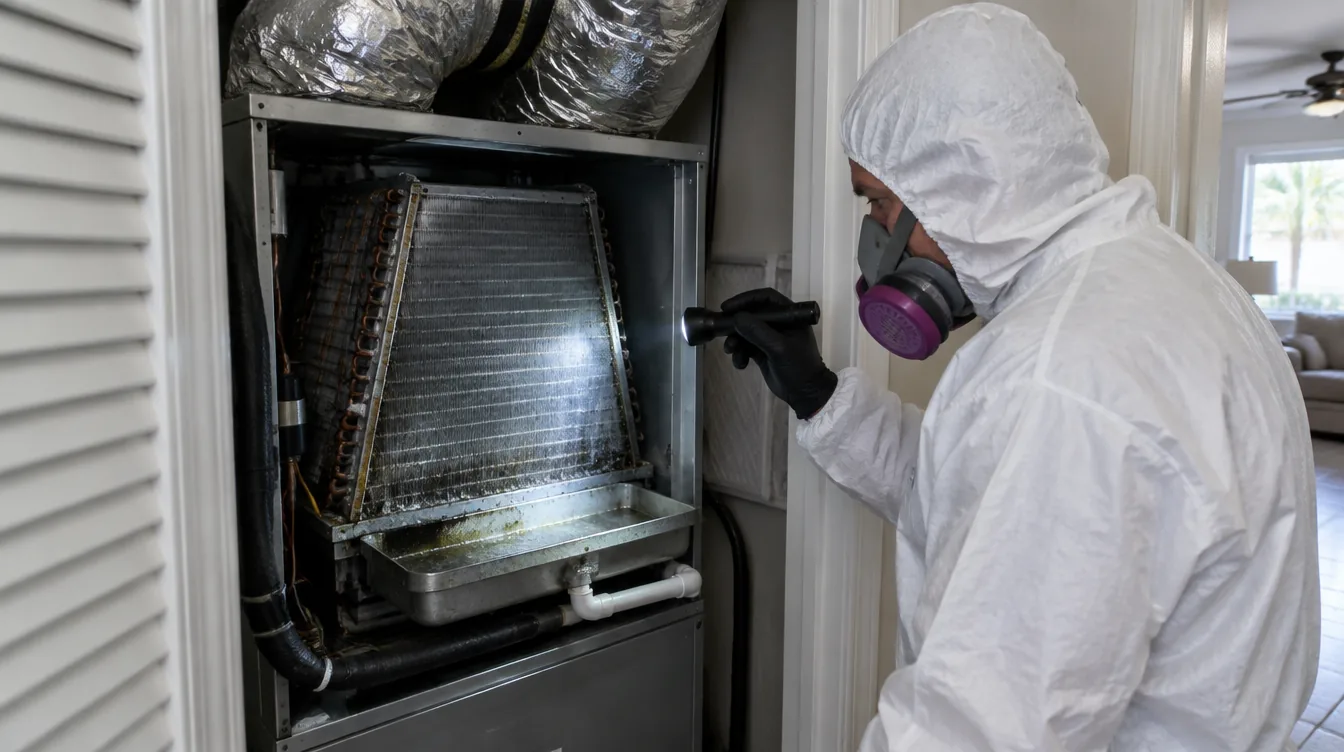
Fort Myers air conditioners run most of the year, and they move the whole house’s air through one closet several times an hour. When an air handler sits in a damp closet or ducts pass through a humid attic, the system can collect contaminated dust and spread it to every room. On mycotoxin projects we check the air handler, coil, drain pan, return and ducts, and we clean them when the protocol calls for it. Cleaning the rooms without cleaning the system that feeds them tends to bring the problem back.
Belongings that went through the storm
A lot of what families keep in Fort Myers homes has been through at least one flood. Boxes that sat in a garage when the river came up, furniture that was dried on the driveway and carried back inside, and keepsakes stored in an attic under an old roof leak can all carry contaminated dust into a clean house. It is one of the most common reasons a home tests clean after remediation and then slowly slips back.
We sort belongings with you, room by room, using what the assessor’s results support:
- Glass, metal, stone, ceramics and hard plastic can almost always be HEPA-vacuumed and wiped.
- Finished wood furniture usually cleans the same way.
- Clothing and washable fabrics are often saved with repeated laundering.
- Mattresses, upholstered pieces, rugs and pillows that sat in flood water or in the affected rooms are usually better replaced.
- Books, papers and photographs need individual judgment, and some can be copied or scanned before they go.
Our page on mycotoxins on belongings goes through the options material by material.
How testing and clearance work in Florida
Florida licenses mold assessors and mold remediators separately. Under Florida Statute 468.8419, an assessor may not remediate a structure it assessed within 12 months, and a remediator may not assess or clear a structure it remediated within 12 months. Certified Division I contractors are the exception. On our Fort Myers projects, an independent licensed mold assessor inspects and samples the home, writes the scope, and performs clearance testing. We do the remediation to that protocol.
For a family working with a doctor, that separation is a real advantage. The company testing your home has no reason to find more mold than is there, and the company removing it can’t grade its own work. The assessor may use air sampling, dust-based mold testing such as ERMI or HERTSMI-2, and a mycotoxin panel on settled dust. Each answers a different question, and our mycotoxin testing page explains how they fit together.
Working with your doctor
Many families come to us after a functional or integrative physician has suggested the home may be involved. With your permission, we’ll talk with that office, explain what the assessor’s results show, and send the clearance report directly. We’ll also help you think through the practical side: which rooms to keep using during the work, which belongings to clean or replace, and whether staying elsewhere for a few days makes sense. Those decisions belong to you and your doctor.
Our Southwest Florida team works across Fort Myers and the rest of Lee, Collier and Charlotte counties. We’re family-owned, in business since 2008, and every project is backed by a complete-removal guarantee. We don’t close a job on a failed result.
We remove mold and mycotoxins from buildings. We don’t diagnose, treat or give medical advice, and home test results are not medical tests. Please rely on your doctor for health decisions. With your permission, we’ll share the results and our plan with them.
Common questions
Have a question that isn't here? Call a specialist
Can renters in Fort Myers arrange mycotoxin remediation?
Remediation changes the building, so the owner has to agree to it. Many tenants start by sharing an independent assessor's report with the landlord. Our guide to mold in Florida rental homes covers how that conversation usually goes, and we can work directly for the owner or property manager.
Do historic Fort Myers homes need a different approach?
They often do. Original plaster, wood floors and trim can usually be cleaned rather than torn out, and we try to save them. We also check whether your street is in a local historic district before any exterior work, since changes there may need review.
My downtown condo flooded in Ian. Could there still be toxins?
It's possible if the unit or the shared spaces were closed up before they dried, or if the cavities behind the new drywall were never cleaned. Testing by an independent assessor is the way to find out, and your association may need to be part of any work in common areas.
Who does the testing in Fort Myers?
An independent licensed mold assessor. Florida Statute 468.8419 generally bars the company that remediates a home from also assessing or clearing it within 12 months, with an exception for certified Division I contractors.
Is bleach enough to deal with mycotoxins?
No. Bleach can kill surface mold, but mycotoxins are not alive, so killing doesn't apply to them. They have to be physically removed with dust and contaminated materials, and what remains broken down with treatments made for that purpose.
Will you talk to my doctor?
Yes, with your permission. We'll explain what the home results show and send the clearance report. We don't give medical advice, and we leave health decisions to you and your doctor.
We're done when the lab says so.
Every remediation ends with clearance testing, and our work is backed by a complete-removal guarantee. We don't close a job on a failed result.
Talk to a specialistTalk with us about your Fort Myers home
Tell us about the house, its history and what your doctor has asked. A specialist will call you back to plan the next step.
Not sure yet? Try the free AI Mold Risk Check