
Charlotte County
Mold remediation in Port Charlotte, FL
Canal neighborhoods between the Peace and Myakka rivers, remediated to an independent assessor's protocol.
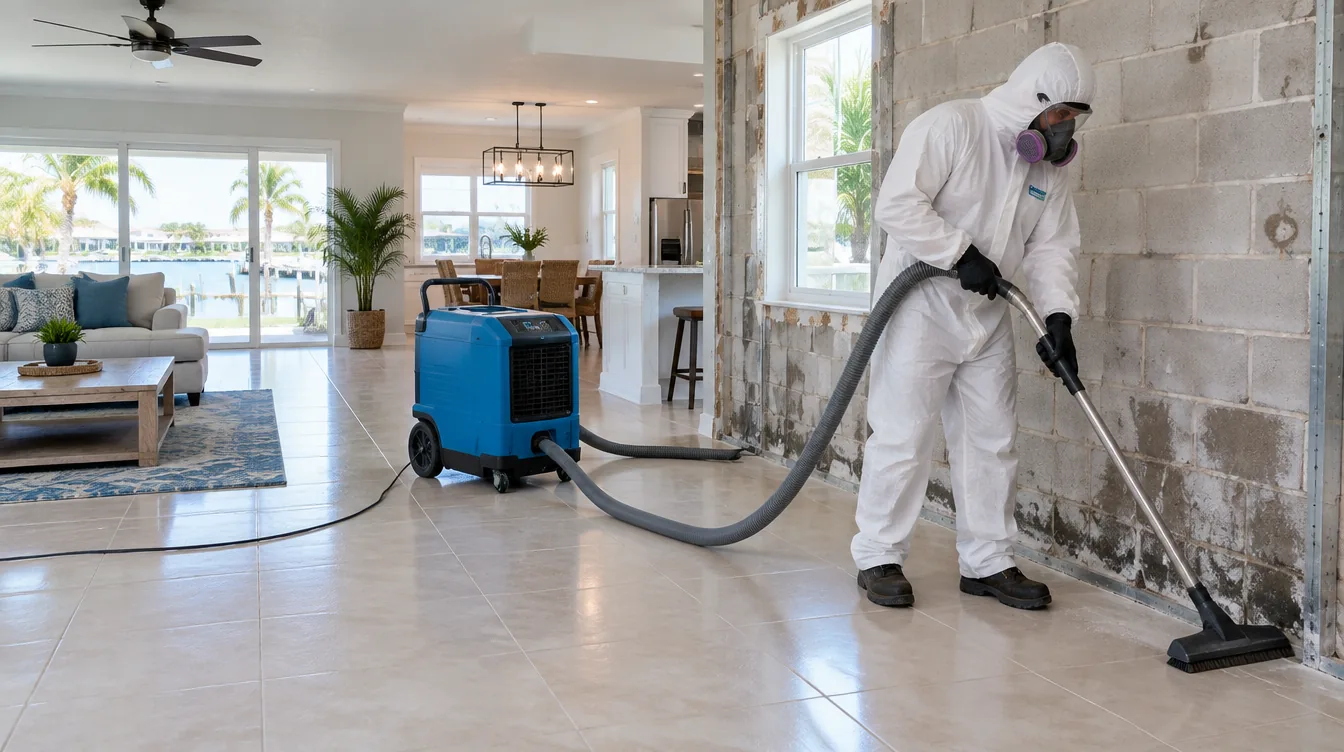
Mold remediation in Port Charlotte, step one
Mold remediation in Port Charlotte, FL starts with knowing what you're dealing with. An independent licensed mold assessor inspects and samples the home and writes the scope. Our Southwest Florida team contains the area, removes what the scope calls for, and cleans block, framing and slab for mold and mycotoxins. The assessor then performs clearance testing, so the company that did the work isn't the one grading it.
Built in the land boom, tested by Charley
Port Charlotte is an unincorporated community of about 60,000 people at the northern end of Charlotte Harbor, between the Peace River and the Myakka River. The General Development Corporation, led by the Mackle brothers, laid it out in the 1950s during Florida's post-war land boom and cut a large network of canals to give thousands of lots water access.
The housing reflects that start: mostly single-family block homes on concrete slabs, the oldest dating back to the community's first years, with newer homes built alongside them since. Older houses may still have aging roofs, original windows and ductwork that has been through decades of humid summers.
Hurricane Charley's eyewall struck Port Charlotte and Punta Gorda in August 2004, destroying or damaging a large share of homes in the county. In 2022, Hurricane Ian brought damaging winds through Port Charlotte again. Wind damage matters for mold because it opens roofs and windows to rain, and that water ends up inside ceilings and walls.
- County
- Charlotte County
- Waterways
- Peace and Myakka rivers, harbor canals
- Typical housing
- Block homes on slabs, from the 1950s on
- Storm history
- Charley 2004, Ian 2022
Mold services in Port Charlotte
- Mold remediationContainment, removal and clearance
- Black mold removalBehind leaks that ran for months
- AC, duct and HVAC moldCoils, drain pans and returns
- Mold inspection and testingIndependent assessor, written scope
- Hurricane and flood moldRoof, wind and water damage
- Mycotoxin testingWhat a toxin panel can show

Why families trust us with their homes
-
Family-owned since 2008
A multigenerational family business. Not a franchise, not a private-equity rollup.
-
Trained and certified
Our team holds IICRC, CMR, CRMI and CCMI credentials in mold remediation and inspection.
-
Called on as experts
Attorneys bring us into legal cases involving mold and mycotoxins.
-
Documentation at every step
Photos, moisture logs and lab reports you can hand to your insurer or FEMA.
- IICRC Certified Firm
- CMR
- CRMI
- CCMI
- BBB A+ Accredited
- NAMRI
- IAQA
- NORMI
- AMMA
- PMII
Nearby communities
Where older slab homes hide mold
Concrete slabs pass moisture up from the ground, and when carpet, pad or laminate covers them, that moisture can collect underneath with nowhere to go. Add a plumbing leak under a vanity, or a water heater in a garage closet that weeped for months, and the bottoms of walls start growing mold where nobody looks. In many Port Charlotte homes, the first clue is a smell rather than a stain.
Our answer on why a Florida house smells musty covers the usual hiding spots and what each one tells you.
Ductwork is another suspect. Ducts that run through a hot attic can sweat when cold air moves through them, and a crushed or poorly insulated section can drip onto the ceiling below. That looks like a roof leak but isn’t, which is why the assessor’s inspection should come before anyone starts cutting drywall.
Storm repairs and what’s behind them
After Charley and again after Ian, many Port Charlotte roofs were patched or replaced. When a roof leaks before it’s fixed, water soaks the ceiling drywall and the insulation above it. If the drywall was painted rather than replaced, mold can keep growing on its back side and up in the attic. A stain that comes back after painting is a sign the source was never removed.
How a Port Charlotte job runs
Florida law separates mold assessment and remediation on the same home, so an independent licensed assessor inspects first and writes the scope. We set up containment with negative air, remove the materials the scope names, HEPA vacuum and clean the block and framing, and treat for mycotoxins using products from US Enzyme. Then the assessor runs clearance. You keep every report, which helps if you sell, refinance or file a claim.
Port Charlotte is part of our Charlotte County service area. Our Southwest Florida page lists every service we offer in the region.
Port Charlotte questions
Have a question that isn't here? Call a specialist
Our roof was damaged in a storm. When should we check for mold?
As soon as the leak is stopped. Water from a roof leak soaks ceiling drywall and attic insulation, and in Port Charlotte's humidity growth can start within a day or two. Have the ceiling and the attic above it checked before patching and painting.
Is black mold common in older Port Charlotte homes?
Stachybotrys, often called black mold, needs materials that stay wet for a long time, like drywall behind a slow leak. It isn't the only mold that matters, and color won't tell you which species you have. Lab analysis from the independent assessor will.
Can you clean our AC ducts?
Yes, when the scope calls for it. If the air handler, coil or ducts show growth, they're cleaned so the AC doesn't redistribute spores and dust after the rest of the house is finished.
Do you also work in North Port and Punta Gorda?
Yes. We serve Punta Gorda and the rest of Charlotte County, and we also work in Englewood and North Port on the Sarasota County side.
We're done when the lab says so.
Every remediation ends with clearance testing, and our work is backed by a complete-removal guarantee. We don't close a job on a failed result.
Talk to a specialistTalk to a specialist about your Port Charlotte home
Tell us what you're seeing and where. Our Southwest Florida team will call you back.
Not sure yet? Try the free AI Mold Risk Check