
Can mold grow on concrete block walls in Florida?
Short answer
Yes, though usually not on the block itself. Concrete block doesn't feed mold, but it soaks up water and releases it slowly. Mold grows on the dust, paint, paper-faced drywall and wood furring strips attached to damp block. In Florida block homes, that growth is often hidden on the back of the drywall on exterior walls or after a flood.
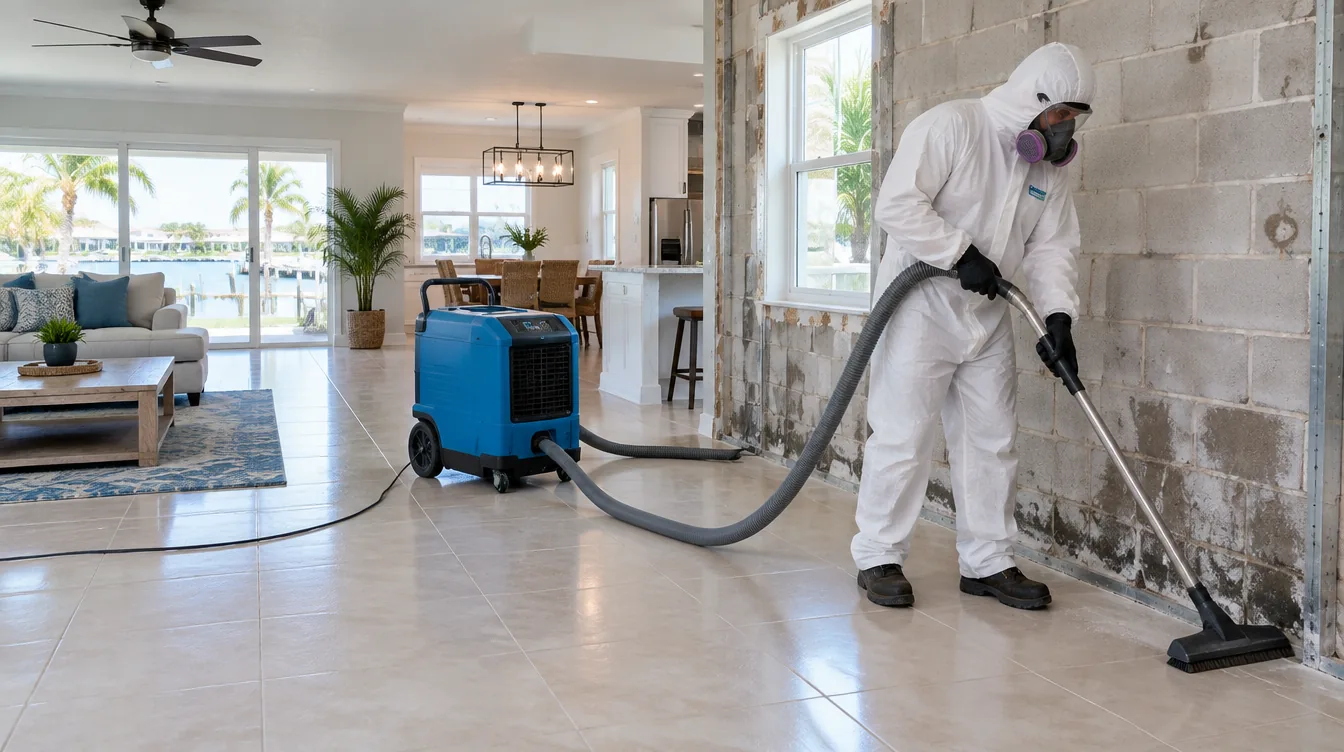
How a Florida block wall is put together
Most homes in Lee, Collier and Charlotte counties, from the 1950s to 1970s ranches to the newer subdivisions, have exterior walls of concrete masonry units, the hollow gray blocks. Stucco covers the outside. On the inside there’s usually a layer of wood or metal furring strips, sometimes a thin insulation board, and then drywall or plaster with paint and baseboards.
Every one of those inside layers can feed mold except the block. Paper-faced drywall, wood furring, the dust that settles in the gaps and even some paints give mold something to eat once they stay damp.
Why block stays wet
Concrete block is porous. It takes on water from several directions and gives it back slowly:
- Wind-driven rain pushes water through hairline cracks in stucco and around window and door frames.
- Flood water and storm surge soak the lower courses of block, and the slab under them.
- Irrigation that sprays the same wall every morning keeps the outside of the block wet.
- Inside, cool air-conditioned surfaces meet humid air, and condensation can form on the back of drywall on exterior walls.
The EPA puts it simply: the key to mold control is moisture control. A block wall that has been soaked can keep the drywall in front of it damp for weeks after the room itself feels dry, which is why storm walls that were closed up too early often grow mold later.
The slab plays a part too. Most Southwest Florida homes sit on a concrete slab with tile on top, and after a flood the slab and the bottom of the block wall dry more slowly than anything above them. Baseboards and the lowest few inches of drywall sit right in that damp zone, so that’s where storm mold usually starts.
Is it mold or efflorescence?
Homeowners often find a white, powdery or crusty deposit on bare block in a garage or behind a cut-out wall. That’s frequently efflorescence: mineral salts carried out of the concrete by water and left behind as it evaporates. It isn’t mold, but it tells you water is moving through the wall.
| Clue | Efflorescence | Mold |
|---|---|---|
| Look | White, crystal or chalky, often in lines along mortar joints | Fuzzy, spotted or smeared, in white, gray, green or black |
| Where | On bare block and concrete | On drywall, paint, wood, dust films and furniture near the wall |
| Smell | None | Often musty |
| What it means | Water is passing through the wall | Water has stayed long enough for growth |
If you can’t tell, don’t scrape it into the air. A licensed assessor can sample it, and the answer changes what needs to happen next.
Where block-wall mold hides
- The back of drywall on exterior walls, especially below windows
- Behind baseboards after any flooding, even a few inches
- Inside kitchen and bathroom cabinets built against exterior walls
- In closets on exterior walls, where air barely moves
- In the AC closet, where a leaking drain pan wets both the drywall and the block
- Garage walls that share a side with living space
How block walls get cleaned
The good news is that block itself rarely needs to come out. It can’t rot, and once it’s dry it can be cleaned. The porous layers in front of it are a different story. On our Southwest Florida jobs, drywall, insulation and wood that grew mold are removed under containment, the exposed block is HEPA-vacuumed and cleaned, and we use plant-based enzyme products to break down mold residue and mycotoxins on the surface. The wall stays open until moisture readings show the block and slab are dry, not until it feels dry.
Before the wall is closed, an independent licensed assessor performs clearance testing. That’s how Florida’s system works under Florida Statute 468.8419, and it means the company removing the mold can’t grade its own work.
Keeping block walls dry
- Seal stucco cracks and failed caulk around windows and doors before rainy season.
- Point irrigation heads away from the house.
- Keep indoor humidity below 60 percent, as the EPA recommends, and keep the AC running when the home is empty.
- After any flood, get the lower drywall opened and the block dried promptly.
For the general science of mold on concrete, see our national page, can mold grow on concrete. For Florida construction in more depth, read mold in concrete block homes.
We're done when the lab says so.
Every remediation ends with clearance testing, and our work is backed by a complete-removal guarantee. We don't close a job on a failed result.
Talk to a specialistMusty smell near an exterior wall?
Tell us where it is and whether the wall has taken water. A Southwest Florida specialist will call you back.
Not sure yet? Try the free AI Mold Risk Check