
Offices, schools, multifamily
Commercial mold inspection, documented room by room
Inspection, sampling and reporting for owners, property managers and schools who need documentation they can defend.
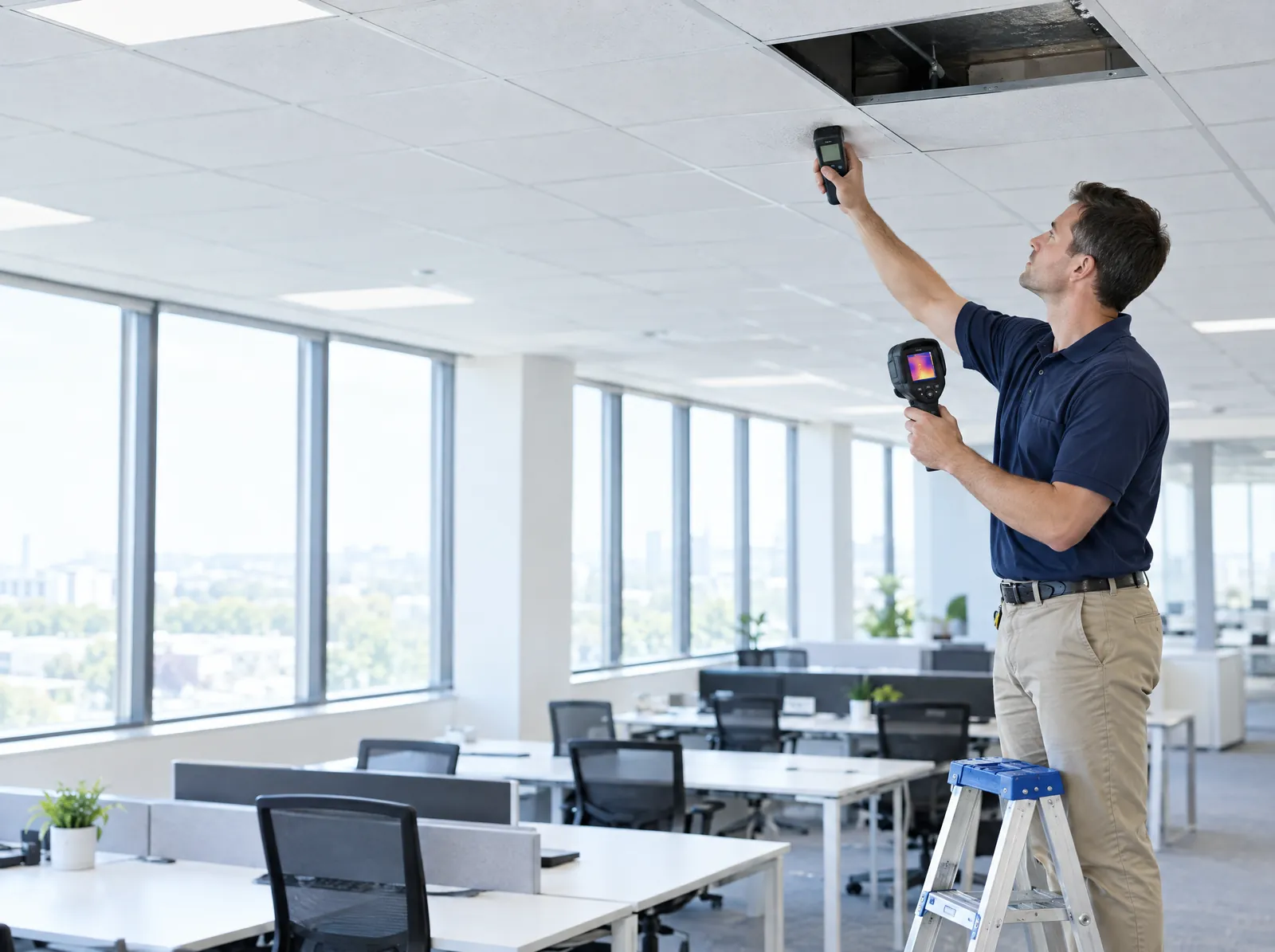
What does a commercial mold inspection include?
A commercial mold inspection is a planned investigation of a building's moisture and mold conditions, documented so owners, managers and occupants can act on it. It covers the roof and building envelope, plumbing, the HVAC system and occupied spaces, using moisture readings, air, surface and dust sampling, and laboratory analysis. The result is a written report with sampling locations, lab data and recommendations that can stand up to review by tenants, insurers or attorneys.
Why commercial buildings need a different approach
A commercial building isn't a large house. Air handlers serve many rooms at once, flat roofs can leak for months before anyone notices, ceiling plenums hide wet insulation and pipe chases, and dozens or hundreds of people share the same air. When a complaint comes in, an owner needs more than a spore count. They need the extent, the cause, the areas and people affected, and a record showing the problem was taken seriously and handled properly.
Sound familiar?
- Tenants or staff are reporting odors or stuffy air, and you need a documented response.
- A roof or plumbing leak soaked ceiling tiles and wall cavities.
- An insurer, lender or attorney wants documentation, not an opinion.
- You need answers without shutting the building down.
We do it differently.
| Residential-style inspection | AME commercial mold inspection | |
|---|---|---|
| Scope | Only the rooms with complaints | A sampling plan covering complaint areas, comparison areas and the air handler zones that serve them |
| HVAC | A glance at the filter | Air handlers, coils, drain pans and accessible ductwork inspected |
| Building envelope | Not considered | Roof, windows, below-grade walls and plumbing chases checked for water entry |
| Occupant input | Not collected | Complaint locations mapped against moisture findings and air zones |
| Report | A short letter | Findings, photos, moisture maps, lab data, chain of custody and recommendations |

Why families trust us with their homes
-
Family-owned since 2008
A multigenerational family business. Not a franchise, not a private-equity rollup.
-
Credentialed where it isn't required
Indiana doesn't license mold remediators. We hold IICRC, CMR, CRMI and CCMI credentials anyway.
-
Called on as experts
Attorneys bring us into legal cases involving mold and mycotoxins.
-
Lab results in 24 to 48 hours
Every inspection comes with a written report, color photos and lab results.
- IICRC Certified Firm
- CMR
- CRMI
- CCMI
- BBB A+ Accredited
- NAMRI
- IAQA
- NORMI
- AMMA
- PMII
The AME Clearance Method
How we inspect a commercial building
Seven steps, scaled to the building. A single suite and a whole school follow the same logic.
Talk to a specialist-
Define the question
Occupant complaints, a known leak, due diligence before a purchase or lease, or a legal matter. The question sets the scope, the sampling plan and the report format.
-
Review building records
Floor plans, HVAC zoning, roof and plumbing repair history, prior reports and complaint logs tell us where to look before we arrive.
-
Inspect the envelope and interiors
Roof drains and penetrations, window frames, below-grade walls, ceiling plenums, restrooms, kitchens and mechanical rooms, with moisture meters and thermal imaging.
-
Inspect the HVAC system
Air handlers and rooftop units, coils, drain pans, internal duct lining and outdoor air intakes. The HVAC system decides how far a problem spreads.
-
Sample to a plan
Complaint areas, non-complaint comparison areas and outdoor controls, organized by air handler zone, plus surface or cavity samples where the inspection points.
-
Lab analysis with chain of custody
Every sample is logged from collection to the lab. Results typically come back in 24 to 48 hours.
-
Report and brief
A written report with findings, photos, lab data and recommendations. We can walk owners, managers or their advisors through it.
What a commercial mold inspection includes
- A scoping call to define the question and the deliverable
- Review of plans, HVAC zoning and maintenance history
- Inspection of roof, envelope, plumbing and interiors
- HVAC inspection of accessible air handlers and ductwork
- Moisture mapping with meters and thermal imaging
- Air, surface and cavity sampling organized by zone
- Outdoor and non-complaint comparison samples
- Chain-of-custody records and accredited lab analysis
- A written report with photos and original lab data
- Recommendations that can serve as the basis for a remediation scope

Proof you can hold in your hands
When we finish, you don't get a handshake and a promise. You get the paperwork your family, your doctor, your insurer or your buyer can rely on.
Inspection report
What we found, where it is coming from, with color photos.
Written remediation plan
Scope, timeline and what will and won't be removed, before work starts.
Clearance lab report
Air, surface and mycotoxin results after the work is done.
A report for your doctor
With your permission, we share results directly with your care team.
Commercial mold inspections, explained
What usually prompts a commercial inspection
- Occupant complaints. Odors, stuffy rooms or a cluster of people in one area who say the air bothers them.
- A water event. A roof leak, a burst pipe, a sprinkler discharge or a backed-up drain, especially one that sat over a weekend.
- Visible growth. Stained ceiling tiles, mold on window frames or supply diffusers, or growth found during a renovation.
- Transactions. Due diligence before buying, leasing or refinancing a property.
- Disputes. A tenant claim, an insurance claim or litigation that needs an independent record.
Building a sampling plan
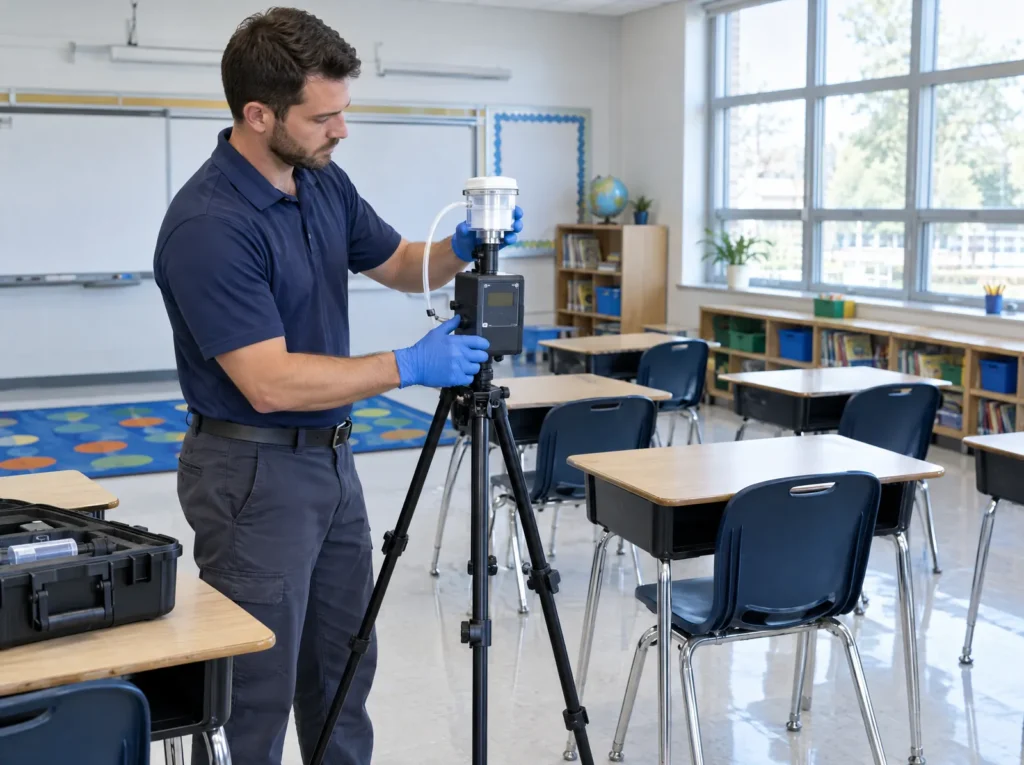
In a house, sampling a few rooms and the outdoors is often enough. In a commercial building, results are only useful if the samples are chosen to answer a specific question. We build the plan around three kinds of locations. Complaint areas are the rooms or suites where the problem was reported. Comparison areas are similar spaces in the same building with no complaints, ideally on a different air handler. Outdoor controls are taken near the building and, where it matters, near the outdoor air intakes.
Organizing samples by air handler zone is what makes the results readable. If the complaint area and its comparison area are on the same unit and both read high, the source may be in the system or somewhere it draws from. If only the complaint area reads high, the source is more likely local: a wet wall, a leaking window or a plenum above the ceiling.
The HVAC system in commercial buildings
Commercial air systems move large volumes of air and often run long hours. Cooling coils and drain pans stay wet through the cooling season, and a pan that doesn’t drain can grow mold right where the air is conditioned. Some duct systems use internal fibrous lining, which can hold dust and moisture and is hard to clean once contaminated. Outdoor air intakes placed near dumpsters, landscaping or standing water can pull in more than fresh air. We inspect what’s accessible and note what isn’t, so the owner knows where the limits of the inspection are.
Documentation that holds up
Commercial reports get read by people who weren’t there: property owners, tenants, insurance adjusters, lenders and sometimes attorneys. That changes how the work is recorded. Every sample location is marked on a floor plan, every moisture reading is logged with a photo, every sample travels with chain-of-custody paperwork, and the original lab reports are attached rather than summarized. Conclusions are tied to the evidence behind them. Attorneys bring us into legal cases involving mold and mycotoxins, and our expert witness page describes that work.
Communicating with occupants
How findings are shared with tenants, staff or families is the owner’s decision, but it helps to plan it before results arrive. Clear, factual updates tend to work better than silence. We can prepare a plain-language summary of the findings and the plan for the owner to share, and we keep our own communication about a building limited to what the owner authorizes.
When the inspection points to cleanup, the report becomes the basis for a remediation scope. See commercial mold remediation for how that work is contained and phased in occupied buildings, and commercial mold remediation in the Midwest for projects near our Avon, Indiana office.
Common questions
Have a question that isn't here? Call a specialist
Are there legal limits for mold in commercial buildings?
There are no federal limits for mold in indoor air, according to the EPA. OSHA doesn't have a mold-specific standard, though employers still have a general duty to provide a safe workplace. Some states and cities add their own rules, so owners often rely on published guidance and documented professional judgment.
Can you inspect while the building is occupied?
Usually, yes. Much of the inspection is quiet and non-invasive. Sampling in occupied spaces can be scheduled around business hours, and any invasive steps, like opening a wall, are planned with the owner.
Do you inspect schools?
Yes. Schools share the commercial challenges of large air systems and flat roofs, with the added need to communicate carefully with families and staff. The EPA's guide to mold remediation in schools and commercial buildings is a common reference for this work.
Do you inspect apartments and other multifamily buildings?
Yes. Multifamily inspections look at individual units and at shared routes for water and air, such as plumbing stacks, shared walls, corridors and common HVAC equipment, since a problem in one unit often starts in another.
Can the report be used in a legal dispute?
It's written to be reviewed. Every finding is tied to photos, readings and lab data with chain-of-custody records. Attorneys bring us into legal cases involving mold and mycotoxins, so we understand what those reports are asked to show.
Do you also do the remediation?
We can, but you don't have to hire us for it. Some owners prefer one firm to inspect and another to remediate, and our report is written so any qualified contractor can use it as a starting point.
How much does a commercial mold inspection cost?
It depends on the building's size, the number of HVAC zones, how many samples the question requires and the report format. We provide a written proposal before any work begins.
We're done when the lab says so.
Every remediation ends with clearance testing, and our work is backed by a complete-removal guarantee. We don't close a job on a failed result.
Talk to a specialistPlan a commercial mold inspection
Tell us about the building and what prompted the call. A specialist will get back to you to scope the inspection.
- (833) 772-6653
- info@americanmoldexperts.com
- Open 7 days, 8am to 8pm