
Can air purifiers remove mycotoxins?
Short answer
Partly. An air purifier with a true HEPA filter can capture airborne spores, mold fragments and dust particles that carry mycotoxins, which reduces what you breathe in that room. It can't reach toxins in settled dust, carpet, furniture or wall cavities, and it doesn't stop the source. Treat it as a helper alongside cleaning and remediation, not a substitute.
What a purifier can actually catch
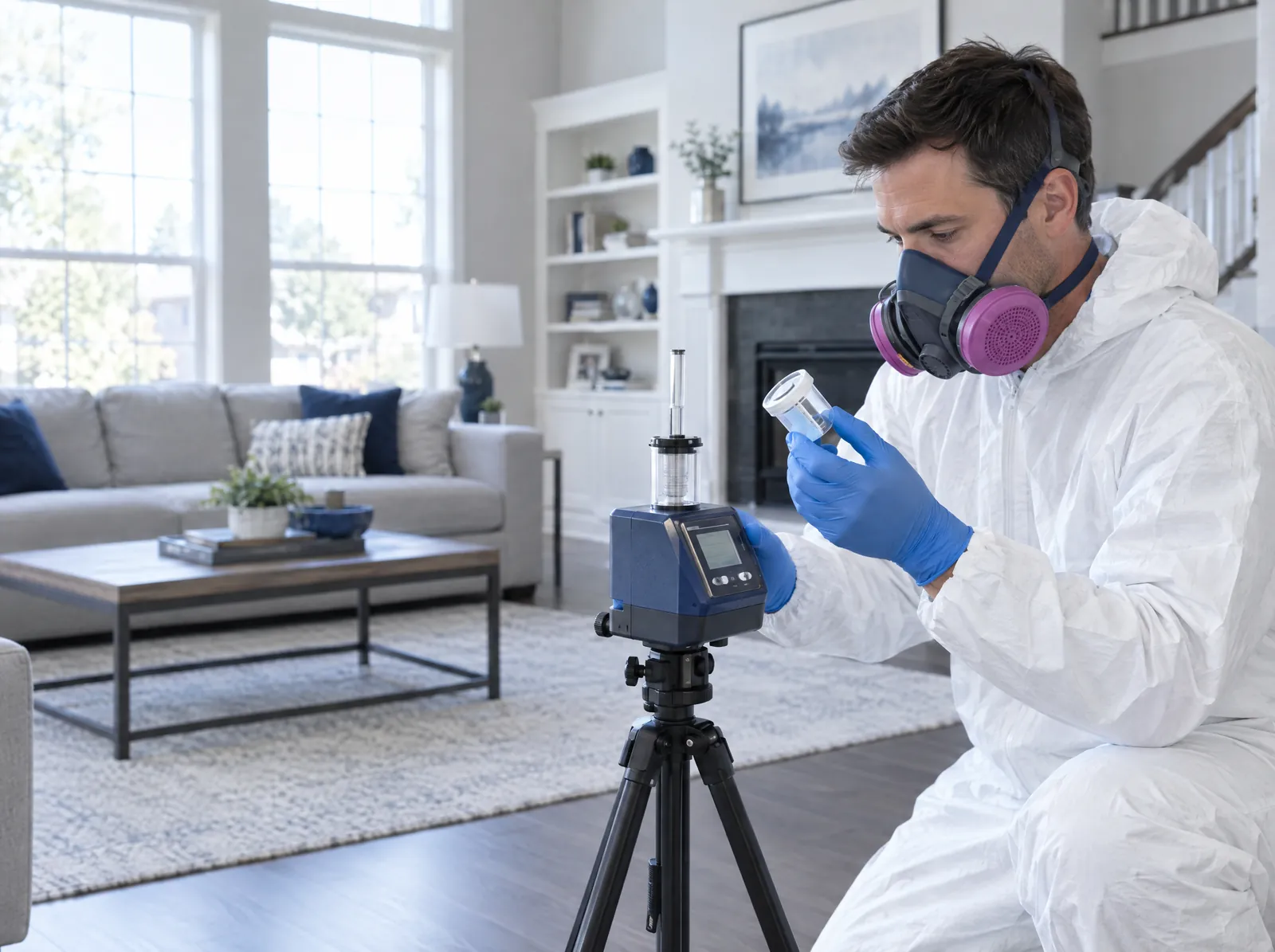
Mycotoxins don’t drift around a room as loose molecules. They travel on spores, on mold fragments smaller than spores, and on ordinary house dust. Our page on whether mycotoxins are airborne explains how that material gets into the air. A purifier with a true HEPA filter pulls room air through a dense fiber mat that traps those particles, and the toxins riding on them are trapped too.
That’s a real benefit, especially in a bedroom where people spend many hours a night. It lowers the amount of particle-bound toxin in the air while the unit runs. During remediation, portable HEPA units also help catch the fine dust that gets lifted as surfaces are cleaned, which is why crews run air scrubbers alongside HEPA vacuums rather than relying on either one alone.
Why it can’t clear a house
- It only treats air that reaches it. Dust on top of a door frame or inside a sofa cushion never passes through the filter.
- Settled dust is the main reservoir. In most affected homes, far more toxin sits in dust and soft materials than floats in the air at any moment.
- The source keeps producing. If mold is still growing behind a wall or in a crawlspace, the purifier is catching new particles, not ending the problem.
- It covers one room. A unit sized for a bedroom does little for the basement or the ductwork.
Types of purifiers compared
| Type | How it works | Useful for toxin-carrying particles? |
|---|---|---|
| True HEPA (mechanical) | Traps particles in a fiber filter | Yes, for particles in the air that passes through |
| Activated carbon | Adsorbs gases and odors | Helps with musty odor, but it isn’t a particle filter on its own |
| UV light | Exposes microbes passing the lamp to UV | Doesn’t remove particles, and air moves past the lamp quickly |
| Ionizer or electrostatic | Charges particles so they cling to plates or surfaces | Particles may simply land on walls and furniture, and some models make ozone |
| Ozone generator | Releases ozone into the room | Not recommended. See does ozone remove mycotoxins? |
Getting the most from one
- Size it for the room. Look at the clean air delivery rate (CADR) on the label and match it to the square footage, or go one size up.
- Run it continuously in the rooms that matter most, such as bedrooms, rather than only when you notice a smell.
- Close the door to the room so the unit isn’t trying to clean the whole floor.
- Change filters on the manufacturer’s schedule. Do it outdoors if you can, and bag the old filter before carrying it through the house.
- Choose a sealed unit. What HEPA filters capture depends as much on the housing as on the filter itself.
When a purifier isn’t enough
If you’re running purifiers and the house still smells musty, dust keeps coming back quickly, or a dust test shows mycotoxins, the purifier is doing its job and the source is winning. That’s the point to bring in help. Mycotoxin remediation deals with the moisture, the contaminated materials and the dust, and then tests to confirm. A purifier is still useful during and after that work.
We remove mold and mycotoxins from buildings. We don’t diagnose or treat medical conditions, and an air purifier is not a medical device. If you have symptoms, please work with a doctor, and we’re happy to share test results with them if you’d like.
We're done when the lab says so.
Every remediation ends with clearance testing, and our work is backed by a complete-removal guarantee. We don't close a job on a failed result.
Talk to a specialistRunning purifiers and still worried?
We can test the dust in your home and show you where the toxins actually are, so you know what a purifier can and can't handle.
- (833) 772-6653
- info@americanmoldexperts.com
- Open 7 days, 8am to 8pm