
What does a mold remediation company do?
Short answer
A mold remediation company finds how far mold has spread, sets up containment so it doesn't spread further during the work, removes growth and the materials that can't be cleaned, HEPA cleans the area, and confirms the result with testing. Good companies also identify the moisture source behind the mold and document every step, although the actual plumbing, roofing or rebuilding is often done by other trades.
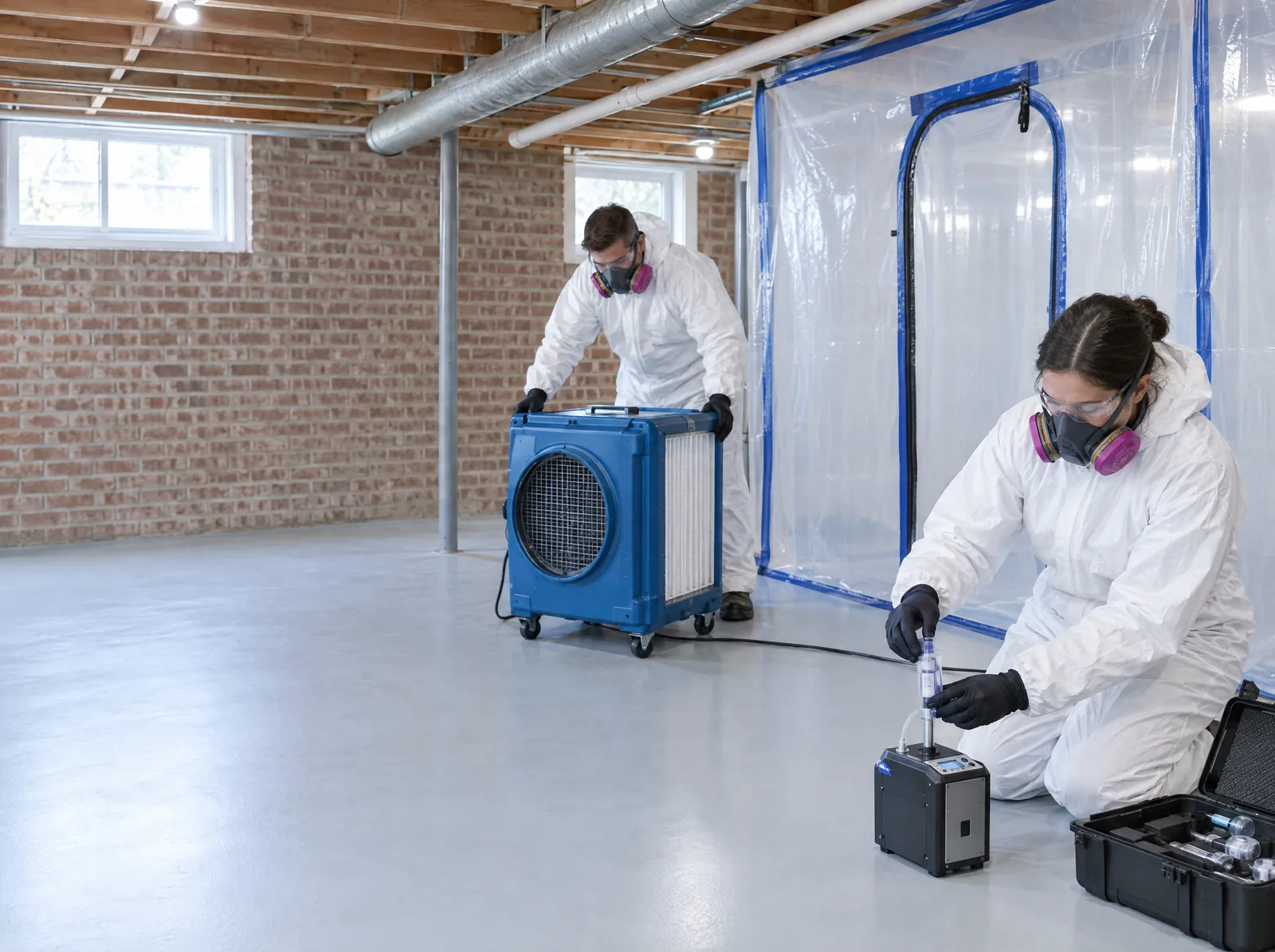
The work, from first visit to final report
Every job is different in size, but the sequence behind a properly run mold remediation job is fairly consistent:
| Stage | What the company does | What you should get |
|---|---|---|
| Assessment | Inspects the home, takes moisture readings, looks for hidden growth and traces where the water came from | A clear description of the affected areas and the likely cause |
| Testing | Air, surface or dust samples sent to a lab, where the situation calls for it | Lab results you can read, not just a verbal opinion |
| Scope and plan | Decides what is cleaned, what is removed and how the area will be isolated | A written scope of work |
| Containment | Seals the work area with plastic sheeting and runs HEPA air filtration under negative pressure | The rest of the house protected while work is underway |
| Removal and cleaning | Removes porous materials with growth, HEPA vacuums and wipes surfaces, treats what stays | Visibly clean, dry materials inside the work area |
| Clearance | Inspects and tests before containment comes down | Results that show the area is back to normal conditions |
| Report | Documents the scope, readings, photos and results | A record for your files, your insurer or a future buyer |
The moisture question
Mold is a symptom of water. A remediation company should find the source and tell you plainly what has to be fixed, whether that is a leaking supply line, a failed shower pan, a roof flashing detail, a crawlspace with no vapor barrier or a basement that runs humid all summer. Some companies make those repairs themselves. Many hand them to a plumber, roofer or waterproofing contractor. Either way, the repair has to happen before the job is closed, or the mold is likely to return.
What’s usually outside the job
It helps to know what a remediation quote does not always include, so nothing falls through the gap:
- Plumbing, roofing or foundation repairs
- Rebuilding: new drywall, paint, flooring and trim after materials are removed
- Cleaning or replacing personal belongings, furniture and textiles
- Structural repairs where rot has weakened framing
- Independent third-party testing, which some owners prefer to arrange separately
Ask about each of these before you sign. Our knowledge page on mold containment covers the part of the job that is easiest to cut corners on and hardest to check afterward.
How to tell a careful company from a quick one
Licensing varies by state. Some states license mold assessors and remediators, and others, including Indiana, don’t license remediators at all. Our answer on whether Indiana requires a license for mold remediation explains what that means in practice. Without a license to check, certifications and process matter more. Look for IICRC training, a written scope, containment described in detail, and testing at the end rather than just a visual check.
Be cautious with any company whose plan is mainly spraying or fogging, or that promises a result before anyone has looked. The questions in what to ask a mold remediation company make those differences visible quickly.
Where we go further
We are an IICRC Certified Firm, family-owned since 2008, and we test before and after every job. Because dead mold can still carry mycotoxins, we also address the fine dust that toxins travel on, and we can test for mycotoxins when a household wants that level of proof. When we use enzyme treatments, they are plant-based products from US Enzyme, used together with removal, HEPA cleaning and clearance testing.
We're done when the lab says so.
Every remediation ends with clearance testing, and our work is backed by a complete-removal guarantee. We don't close a job on a failed result.
Talk to a specialistSee what a remediation plan looks like
Tell us where you've found mold and what happened before it appeared. A specialist will explain what the work in your home would involve and what testing makes sense first.
- (833) 772-6653
- info@americanmoldexperts.com
- Open 7 days, 8am to 8pm