
Southwest Florida guide
Florida mold license law, explained for homeowners
Florida licenses the people who test for mold and the people who remove it. Here's what that means for you.
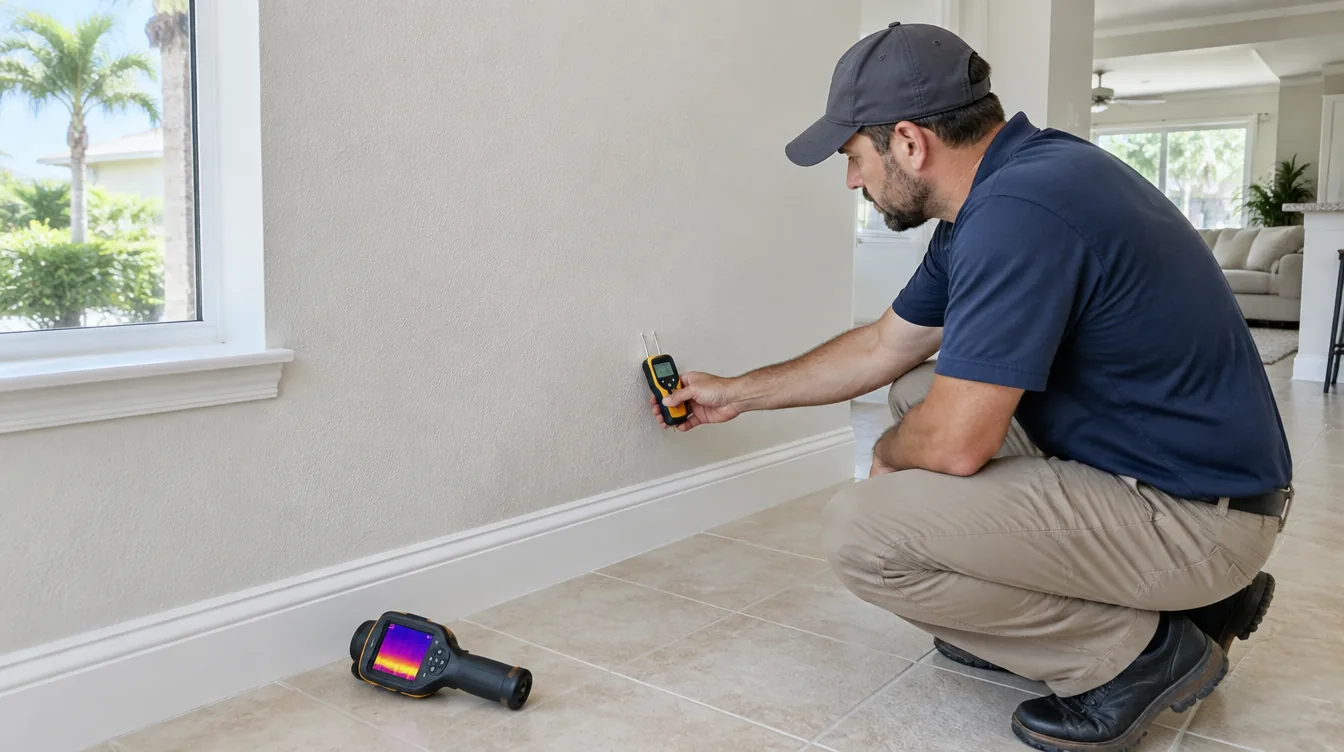
What does Florida mold license law require?
Florida mold license law, found in Chapter 468, Part XVI of the Florida Statutes, requires people who perform mold assessment or mold remediation for the public on areas larger than 10 square feet to be licensed by the Department of Business and Professional Regulation. It creates two separate licenses, mold assessor and mold remediator, and under s. 468.8419 generally bars one company from both assessing and remediating the same structure within 12 months.
Why the law matters when you're hiring
Mold work is easy to sell and hard for a homeowner to check. The company that finds the problem can make it look bigger than it is, and the company that removes it can declare its own work a success. Florida's law tackles both risks directly. It requires training, insurance and an exam for both roles, and it keeps the tester and the remover apart.
Sound familiar?
- You don't know whether the company you called is licensed.
- One company offered to test, remove and clear the mold all by itself.
- The mold test and the remediation quote came from the same business.
- After a storm, door-to-door crews are offering mold work.
We do it differently.
| What some companies offer | What Florida law expects | |
|---|---|---|
| Who tests | Same company that removes | A licensed assessor, independent of the remediator |
| Titles | Anyone can say mold expert | Titles like mold assessor or mold remediator require a license |
| Referrals | Kickbacks between tester and remover | Referral payments between assessors and remediators are prohibited |
| Contract | Verbal agreement | Must be a written or electronic document signed by both parties |
| Insurance | Unknown | At least $1 million general liability for both roles |

Why families trust us with their homes
-
Family-owned since 2008
A multigenerational family business. Not a franchise, not a private-equity rollup.
-
Trained and certified
Our team holds IICRC, CMR, CRMI and CCMI credentials in mold remediation and inspection.
-
Called on as experts
Attorneys bring us into legal cases involving mold and mycotoxins.
-
Documentation at every step
Photos, moisture logs and lab reports you can hand to your insurer or FEMA.
- IICRC Certified Firm
- CMR
- CRMI
- CCMI
- BBB A+ Accredited
- NAMRI
- IAQA
- NORMI
- AMMA
- PMII
The AME Clearance Method
How to check a mold company in Florida
Five steps you can do from your phone before anyone starts work.
Talk to a specialist-
Ask which role they're playing
Are they assessing, remediating or both? If both, on the same home, ask how they comply with s. 468.8419, including whether they're a certified Division I contractor.
-
Get the license holder's name and number
Florida licenses individuals, not companies. Ask for the licensed assessor or remediator responsible for your job.
-
Look it up with the DBPR
Search the name or license number on MyFloridaLicense.com and confirm the license is current and the type matches the work.
-
Confirm insurance in writing
Ask for a certificate of insurance. Florida requires at least $1 million in general liability for both assessors and remediators.
-
Get a written contract
Florida requires mold assessment and remediation contracts to be in a signed document or electronic record. Read the scope before you sign.
What Florida's mold law covers
- Separate licenses for mold assessors and mold remediators
- An exam, plus education or field experience requirements
- Documented training in water, mold and respiratory protection
- Fingerprinting and a background check
- Minimum insurance for both license types
- Continuing education to renew
- Written contracts for assessment and remediation
- The 12-month rule on assessing and remediating the same structure
- A ban on referral payments between assessors and remediators
- Criminal penalties for violations

Proof you can hold in your hands
When we finish, you don't get a handshake and a promise. You get the paperwork your family, your doctor, your insurer or your buyer can rely on.
Inspection report
What we found, where it is coming from, with color photos.
Written remediation plan
Scope, timeline and what will and won't be removed, before work starts.
Clearance lab report
Air, surface and mycotoxin results after the work is done.
A report for your doctor
With your permission, we share results directly with your care team.
Florida mold licensing, explained
Where the law lives
Florida’s mold rules are in Chapter 468, Part XVI of the Florida Statutes, titled Mold-Related Services. The Department of Business and Professional Regulation (DBPR) licenses and regulates the people who do the work. The part defines the key terms, sets out who qualifies for a license, lists exemptions, and spells out what licensees may not do.
This page is a plain-English summary for homeowners. It isn’t legal advice, and statutes change. If you’re in a dispute with a contractor or deciding whether to sign something, talk to a Florida attorney.
Two licenses, two jobs
The statute defines mold assessment as sampling and evaluating information from a building’s history and inspection to form an initial hypothesis about the origin, identity, location and extent of mold growth greater than 10 square feet. A mold assessor is anyone who performs or directly supervises that work.
Mold remediation is the removal, cleaning, sanitizing, demolition or other treatment of mold or mold-contaminated matter greater than 10 square feet, including preventive activities. A mold remediator is anyone who performs it. Work that needs a construction license under Chapter 489 still needs that license.
To be licensed, applicants must pass an approved exam, show good moral character, meet an education or field experience requirement, have documented training in water, mold and respiratory protection, and submit fingerprints for a background check. Assessors must carry at least $1 million in general liability and errors and omissions coverage, and remediators at least $1 million in general liability that specifically covers mold claims. Renewal requires 14 hours of continuing education every two years.
The rule that separates testing from removal
Section 468.8419 is the part most homeowners feel. It says a mold assessor, or the assessor’s company, may not remediate a structure it assessed within the last 12 months. It also says a remediator, or the remediator’s company, may not assess a structure it remediated within the last 12 months. Certified Division I contractors under s. 489.105(3) are exempt from those two bans, and the DBPR may require them to tell homeowners they have the right to request competitive bids.
The same section also says an assessor may not:
- Inspect for a fee a property in which the assessor or the assessor’s company has a financial or transfer interest.
- Accept, or offer, payment or other rewards from a remediator for referring business.
- Take an assessment whose findings, or whose fee, depend on what the assessment concludes.
Remediators face the mirror-image limits: no referral payments to or from assessors, and no paid remediation on a property they have a financial or transfer interest in. Penalties climb with each violation, from a second-degree misdemeanor for a first offense to a third-degree felony for a third.
Who is exempt
Section 468.841 lists exemptions. The ones homeowners run into most are:
- A residential property owner doing mold assessment or remediation on their own property.
- Employees working on property their employer owns, leases or manages, as long as the employer doesn’t offer mold services to the public.
- Certain other licensed professionals, such as contractors and home inspectors, working within the scope of their own license. They can’t hold themselves out as a licensed mold assessor or remediator without that license.
How to verify a license
Florida licenses people, not companies, so ask for the name of the licensed assessor or remediator responsible for your job. Then look them up on the DBPR licensee search at MyFloridaLicense.com, by name or license number. The DBPR’s Mold-Related Services page has more on the program, and its FAQs explain how to file a complaint, including about unlicensed activity.
How we work within it
On our Southwest Florida projects, an independent licensed mold assessor inspects and samples the home, writes the scope, and performs clearance testing. We do the remediation to that protocol. The company testing your home has no reason to find more mold than is there, and the company removing it can’t grade its own work. For the practical side of hiring, read our guide on choosing a mold company in Florida.
This guide summarizes Florida statutes for general information only. It isn’t legal advice. For advice about your situation, contract or dispute, speak with a Florida attorney.
Common questions
Have a question that isn't here? Call a specialist
Does Florida require a license for mold remediation?
Yes, for work covered by Chapter 468, Part XVI. The law defines mold remediation as removing, cleaning, sanitizing, demolishing or otherwise treating mold or mold-contaminated matter larger than 10 square feet, and requires people who do it for the public to be licensed, with some exemptions.
Can the same company test and remove mold in Florida?
Generally not on the same structure within 12 months. Under s. 468.8419, an assessor can't remediate a structure it assessed, and a remediator can't assess one it remediated. Certified Division I contractors are the exception.
How do I look up a Florida mold license?
Use the licensee search on MyFloridaLicense.com, run by the Department of Business and Professional Regulation. You can search by name or license number, and the DBPR's mobile app offers the same lookup.
Do I need a license to remove mold in my own home?
The law exempts a residential property owner who performs mold assessment or remediation on their own property. Doing it safely is another question. The EPA suggests larger areas, roughly over 10 square feet, are generally a job for professionals.
Is a clearance test an assessment under Florida law?
Clearance testing is part of what an assessor does, and s. 468.8419 bars a remediator from assessing a structure it remediated within 12 months. That's why clearance on most Florida jobs comes from an independent assessor.
What if a company isn't licensed?
You can file a complaint with the DBPR, including for unlicensed activity, through MyFloridaLicense.com. If you've already paid or signed, talk to an attorney about your options.
We're done when the lab says so.
Every remediation ends with clearance testing, and our work is backed by a complete-removal guarantee. We don't close a job on a failed result.
Talk to a specialistQuestions about how a Florida mold job should work?
Tell us where you are in the process. A Southwest Florida specialist will call you back and explain the steps.
Not sure yet? Try the free AI Mold Risk Check