
Southwest Florida guide
Humidity and mold in Florida homes
In Southwest Florida the air itself carries the water. Here's how AC and dehumidifiers keep it out of your walls.
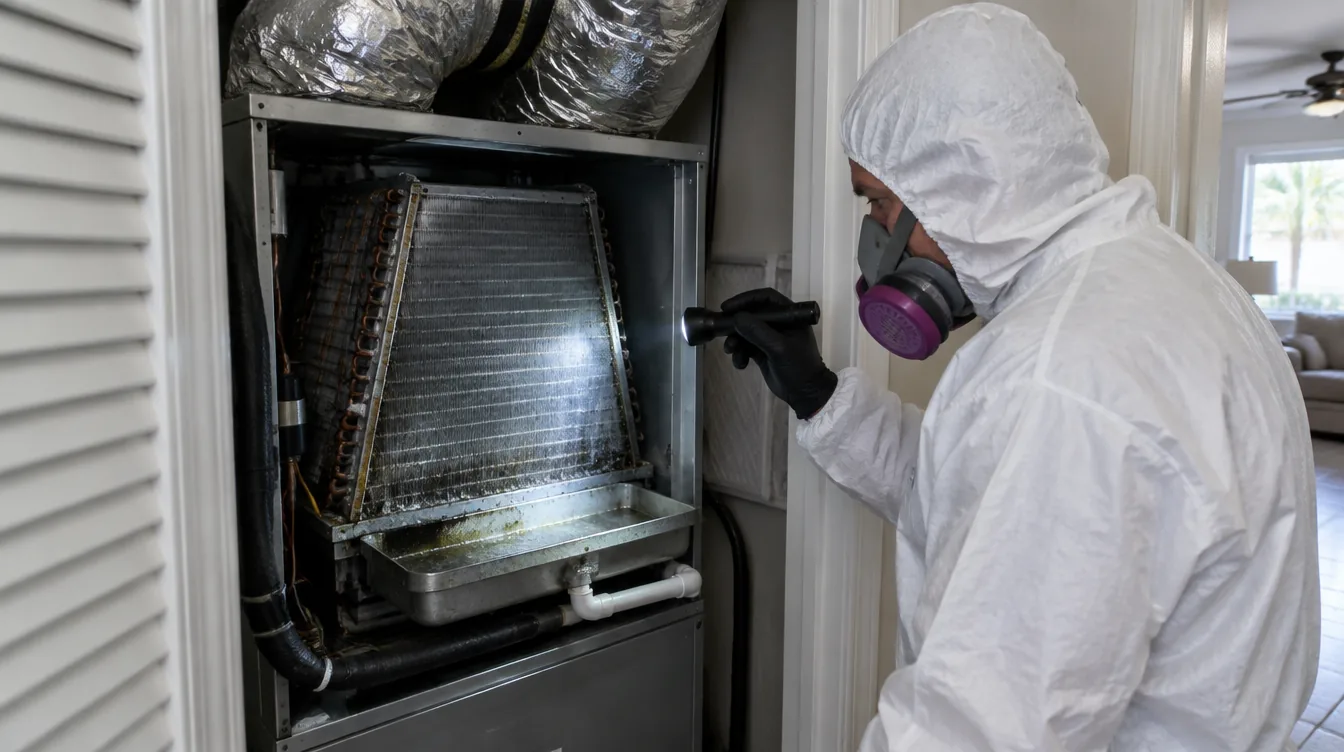
How are humidity and mold connected in Florida homes?
Humidity and mold in Florida homes are linked because mold needs moisture, and Southwest Florida air holds a lot of it for much of the year. When indoor humidity stays high, water settles on cool surfaces like AC vents, closet walls and the back of furniture, and mold follows. The EPA recommends keeping indoor humidity below 60 percent, ideally between 30 and 50 percent, which in Florida usually depends on a well-sized, well-maintained air conditioner.
Why a Florida house can grow mold with no leak at all
In colder states, mold usually starts with a leak or a flood. Here it often starts with the air. Warm, damp outdoor air finds its way in through doors, gaps and duct leaks, and your air conditioner is the main thing pulling that water back out. When the system is oversized, poorly maintained or switched off for long stretches, the moisture stays in the house and settles wherever surfaces are cool.
Sound familiar?
- The house feels cool but clammy, even with the AC running.
- There are dark spots around ceiling vents or on the AC closet door.
- Closets and shoes smell musty after a few weeks of summer.
- You're not sure what to do with the AC when you leave for the season.
We do it differently.
| Common assumption | What actually matters in Florida | |
|---|---|---|
| Cold air | A cold house is a dry house | Temperature and humidity are separate; check both |
| AC size | Bigger is better | An oversized system can cool fast and leave moisture behind |
| Drain line | Only matters when it overflows | A slow drain keeps water sitting in the air handler |
| Dehumidifier | Not needed with central air | Useful in closed rooms, closets and closed-up homes |
| Musty smell | Just old-house smell | Often a sign of moisture and growth you can't see |

Why families trust us with their homes
-
Family-owned since 2008
A multigenerational family business. Not a franchise, not a private-equity rollup.
-
Trained and certified
Our team holds IICRC, CMR, CRMI and CCMI credentials in mold remediation and inspection.
-
Called on as experts
Attorneys bring us into legal cases involving mold and mycotoxins.
-
Documentation at every step
Photos, moisture logs and lab reports you can hand to your insurer or FEMA.
- IICRC Certified Firm
- CMR
- CRMI
- CCMI
- BBB A+ Accredited
- NAMRI
- IAQA
- NORMI
- AMMA
- PMII
The AME Clearance Method
Keeping humidity down in a Southwest Florida home
Six habits that do more for mold prevention here than any spray or fogger.
Talk to a specialist-
Measure it
Put an inexpensive digital hygrometer in the main living area and one in a closet or back bedroom. Numbers beat guesses, and they show you where the house runs damp.
-
Keep the AC doing its job
Have the system serviced, change filters on schedule and ask whether it is correctly sized. A system that runs in short bursts removes less water from the air.
-
Clear the condensate drain
The EPA advises keeping AC drip pans clean and drain lines flowing. A clogged line leaves standing water right where the air handler moves air through the house.
-
Vent moisture at the source
Run bathroom exhaust fans during and after showers, use the range hood when cooking, and make sure the dryer vents outside, not into the garage or attic.
-
Add dehumidification where air is still
Closets, back rooms and homes closed up for the season benefit from a dehumidifier that drains on its own, set to hold humidity under 60 percent.
-
Act on smells and stains
A musty smell or spotting near vents means moisture has already won somewhere. That's the time for an inspection, not another air freshener.
Humidity trouble spots to check in a Florida home
- Supply vents and ceiling registers that sweat
- The AC closet walls, door and floor
- The air handler drain pan and condensate line
- Closets on exterior walls
- Behind furniture pushed against block walls
- Bathrooms without working exhaust fans
- Under kitchen and bathroom sinks
- Window sills and sliding door tracks
- Garage walls shared with living space
- Rooms kept closed with vents shut

Proof you can hold in your hands
When we finish, you don't get a handshake and a promise. You get the paperwork your family, your doctor, your insurer or your buyer can rely on.
Inspection report
What we found, where it is coming from, with color photos.
Written remediation plan
Scope, timeline and what will and won't be removed, before work starts.
Clearance lab report
Air, surface and mycotoxin results after the work is done.
A report for your doctor
With your permission, we share results directly with your care team.
Florida humidity and mold, explained
Why humidity matters more here than almost anywhere
Mold needs three things: moisture, a mild temperature and something to feed on. A Southwest Florida home supplies the last two every day of the year. Drywall paper, wood, dust and fabric are all food, and indoor temperatures stay in the range mold likes. That leaves moisture as the one thing you can actually control, and in this climate most of that moisture arrives through the air rather than through a leak.
From late spring into the fall, outdoor air along the Gulf coast is warm and heavy with water. Every time a door opens, and through every gap around windows, plumbing and ductwork, some of that air comes inside. When it touches something cooler, such as a supply vent, the back of a closet on an exterior wall, or a room kept extra cold, the water condenses. Give that surface a few damp weeks and mold has everything it needs.
Your air conditioner is a dehumidifier first
Most people think of the AC as a cooling machine. In Florida it’s just as important as a drying machine. As house air passes over the cold coil in the air handler, water condenses on the coil, drips into a pan and leaves through the condensate line. That’s why the line outside drips steadily all summer, and why a healthy system matters so much.
Three things undermine it:
- Oversizing. A system that is too big for the house cools it quickly and shuts off before it has pulled much water out. ENERGY STAR notes that this short cycling leads to poor humidity control, especially in humid climates. The result is the cold, clammy house many Floridians know.
- A slow or clogged drain. Algae and sludge build up in condensate lines. When water backs up into the pan, the air handler becomes a damp box that moves air through every room.
- Long stretches with the system off. A house closed up for the summer with the AC switched off can climb to outdoor humidity levels within days.
If you already see growth on vents or around the air handler, stop and read our page on AC and duct mold in Southwest Florida. The EPA advises against running an HVAC system you know or suspect is contaminated, because it can spread mold through the building.
What numbers to aim for
The EPA’s guidance is to keep indoor relative humidity below 60 percent, ideally between 30 and 50 percent. Our national answer on what humidity level prevents mold explains where those numbers come from. For a Florida home, a practical approach is:
- Check a hygrometer in two or three rooms for a week before changing anything.
- If readings sit above 60 percent with the AC running normally, have the system checked for size, airflow and drainage before adding equipment.
- Use a self-draining dehumidifier for problem rooms, closets or a home that will sit empty.
- Keep interior doors and vents open so conditioned air reaches every room.
We don’t recommend a single thermostat number for every home, because the right setting depends on the system, the house and whether anyone is living there. Our short answer on what temperature to set your AC to prevent mold covers the trade-offs.
Where humidity mold hides in Florida houses
Humidity-driven mold rarely looks like the dramatic growth after a flood. It shows up as a gray film on vent covers, spotting on the back of a closet wall, a dusty green bloom on leather shoes or a musty smell when you open a guest room. Block exterior walls with drywall over them are a common spot, because the wall surface can run cooler than the room. Furniture pushed tight against those walls traps still, damp air behind it.
When prevention isn’t enough
Once growth covers more than a small patch, or keeps coming back after cleaning, the humidity problem has become a mold problem. In Florida, an independent licensed mold assessor inspects and samples the home, writes the scope, and performs clearance testing. We do the remediation to that protocol. Florida Statute 468.8419 keeps those roles separate, so the company testing your home has no reason to find more mold than is there, and the company removing it can’t grade its own work.
Not sure whether what you’re seeing is worth a call? Our free AI Mold Risk Check takes about three minutes and helps you sort out what to look at first.
We remove mold and mycotoxins from buildings. We don’t diagnose or treat medical conditions. If anyone in your home has symptoms, please work with a doctor. With your permission, we’re glad to share test results and our plan with them.
Common questions
Have a question that isn't here? Call a specialist
What humidity should I keep my Florida home at?
The EPA recommends keeping indoor relative humidity below 60 percent, and ideally between 30 and 50 percent. In Southwest Florida's wet season, holding the house near the middle of that range usually takes a working AC and sometimes a dehumidifier.
Does running the AC prevent mold?
It helps, because air conditioning removes moisture as well as heat. It only works well if the system is sized correctly, the coil and drain pan are clean, and the condensate line drains freely. A dirty or contaminated system can spread spores instead.
Why does my house feel cold and damp at the same time?
That clammy feeling usually means the AC is lowering the temperature without removing enough moisture. ENERGY STAR notes that oversized systems that cycle on and off quickly do a poor job of dehumidifying, especially in humid climates.
Do I need a dehumidifier if I have central air?
Not always. Many Florida homes stay in range with a healthy AC alone. A dehumidifier earns its place in closets, rooms with poor airflow, homes that sit empty for months, and houses where the hygrometer keeps reading above 60 percent.
Should I turn the AC off when I leave for the summer?
Switching it off entirely lets humidity climb, which is how many closed-up Florida homes grow mold. Our seasonal home guidance covers what to set and what to have someone check while you're away.
Can I just clean the mold off my AC vents?
Surface spotting on a vent cover can be cleaned, but it's a sign the air around it is too wet or the system has a problem. If growth keeps returning or the air handler itself is involved, the system needs to be inspected, not just wiped.
We're done when the lab says so.
Every remediation ends with clearance testing, and our work is backed by a complete-removal guarantee. We don't close a job on a failed result.
Talk to a specialistMusty house even with the AC on?
Tell us what you're noticing and where. A Southwest Florida specialist will call you back and talk it through.
Not sure yet? Try the free AI Mold Risk Check