
Why does my Florida house smell musty?
Short answer
A musty smell in a Florida house usually means there's too much moisture, and often mold you can't see. The most common causes are humidity the AC isn't removing, a dirty or clogged AC system, hidden leaks behind drywall or cabinets, and homes left closed up in summer. The EPA notes that a moldy smell without visible growth can point to hidden mold.
What you’re smelling
That earthy, stale smell comes from gases that mold and bacteria give off as they grow on damp materials. You can smell them long before you can see anything. The EPA’s guide to mold and moisture says a moldy odor with no visible growth can mean mold is hidden behind drywall, under carpet or inside ductwork. Our national page on whether a musty smell always means mold covers the exceptions.
In Florida, the question is less whether there’s moisture and more where it’s collecting. The air outside is humid for much of the year, so the house depends on its air conditioning to stay dry. When that system or the building shell falls behind, the smell shows up.
The usual Florida causes
| Cause | Clues | Where to look |
|---|---|---|
| AC not removing humidity | Rooms feel cool but clammy; smell is worse in summer | Thermostat settings, system size, how often it cycles |
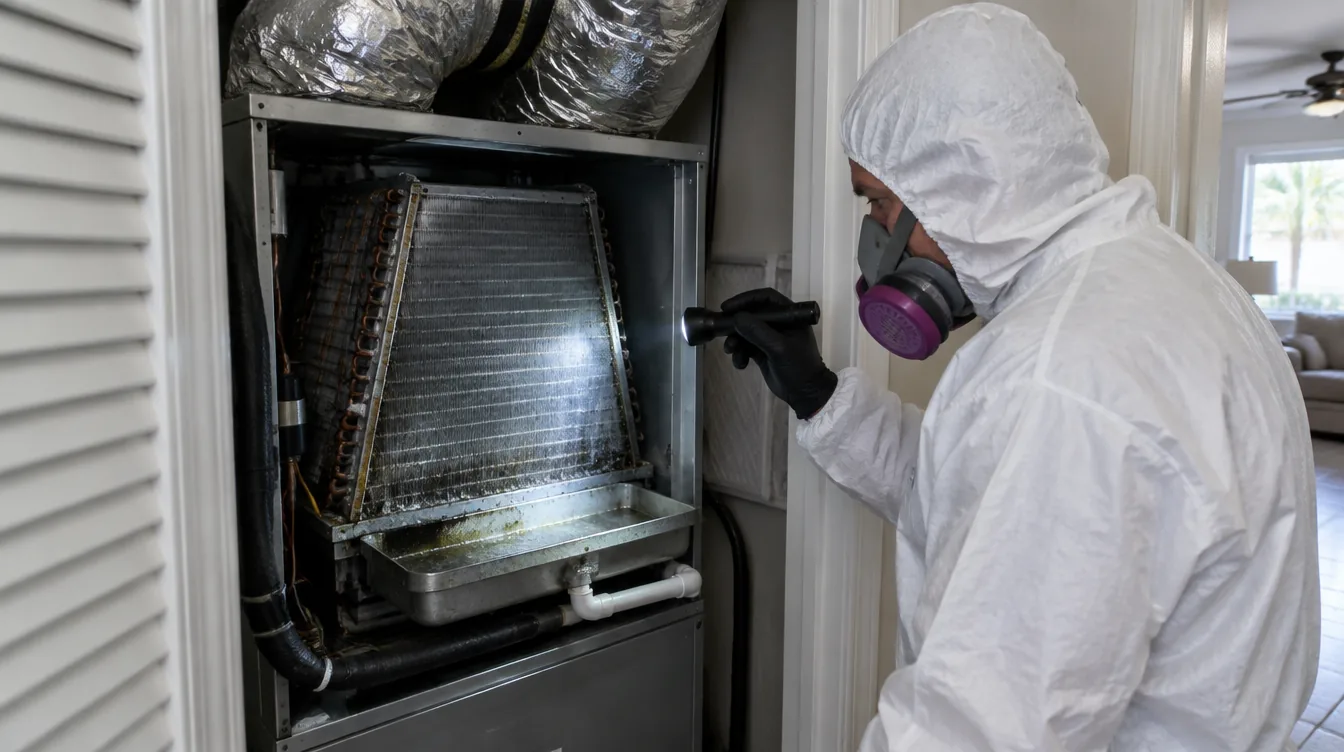
| Mold in the AC system | Smell is strongest right after the AC kicks on | Air handler, drain pan, coil, return and supply vents |
| Clogged condensate line | Water or rust in the AC closet, stained ceiling nearby | AC closet floor, drain pan, ceiling below |
| Leaks in block walls or windows | Smell after heavy rain; stains or peeling paint low on exterior walls | Under windows and sliders, behind baseboards |
| Plumbing leaks | Smell in one room or cabinet | Under sinks, behind toilets, washer and water heater |
| Closed-up house | Smell when you return after weeks away | Closets, bedding, upholstery, the AC closet |
| Past storm damage | Smell that started after a hurricane and never left | Lower drywall, cabinets, anywhere that took water |
When the AC is the problem
An air conditioner only dehumidifies while it runs long enough for moisture to condense on the coil and drain away. ENERGY STAR notes that an oversized system that cycles on and off quickly cools the air without removing enough humidity, and that damp air can promote mold. A clogged drain line, a rusted pan or a dirty coil can also let the system itself grow mold and spread the smell to every room.
If the smell follows the AC cycle, start with our guide on how to tell if there is mold in your AC. Don’t run a system that you know took on flood water until it has been checked.
If the smell greets you when you come back
Many Southwest Florida homes sit empty for months. With the AC off or set too high, humidity climbs, and closets, mattresses and upholstery can pick up that smell even without a leak. If you close the house for the summer, read should I leave my AC on when I leave my Florida home and our seasonal home mold page before you go.
Quick checks you can do today
- Buy an inexpensive humidity meter. The EPA recommends keeping indoor humidity below 60 percent, ideally between 30 and 50 percent.
- Open the AC closet and look for water, rust, slime in the drain pan or a musty smell that’s stronger there.
- Note when the smell is worst: after the AC starts, after rain, or after the house was closed up.
- Look under sinks and at the bottom of exterior walls, closets and cabinets.
- Check whether anything in the house got wet in the last storm and was never opened up.
What not to do
Air fresheners, candles and odor foggers cover the smell without touching the source. Ozone machines are sometimes sold as a fix; our page on whether ozone removes mycotoxins explains why we don’t rely on them. Painting over a stain seals the problem in.
Finding a hidden source
If the smell persists and you can’t find the cause, it’s time for an inspection with moisture readings. In Florida, that assessment and any sampling are done by a licensed mold assessor who is independent of the company doing the removal. The assessor finds the source and writes the scope, and if remediation is needed, we do the work to that protocol.
Not sure how serious it is? Our free AI Mold Risk Check takes about three minutes and helps you decide what to do next.
We remove mold and mycotoxins from buildings. We don’t diagnose or treat medical conditions. If anyone in the home has symptoms, please work with a doctor. With your permission, we’re glad to share test results and our plan with them.
We're done when the lab says so.
Every remediation ends with clearance testing, and our work is backed by a complete-removal guarantee. We don't close a job on a failed result.
Talk to a specialistCan't find the source of the smell?
Tell us when you notice it and where it's strongest. A Southwest Florida specialist will call you back.
Not sure yet? Try the free AI Mold Risk Check