
Southwest Florida guide
Mold in new construction in Florida
A brand-new house can still start life wet. Here's where mold hides in new Florida homes and what to do.
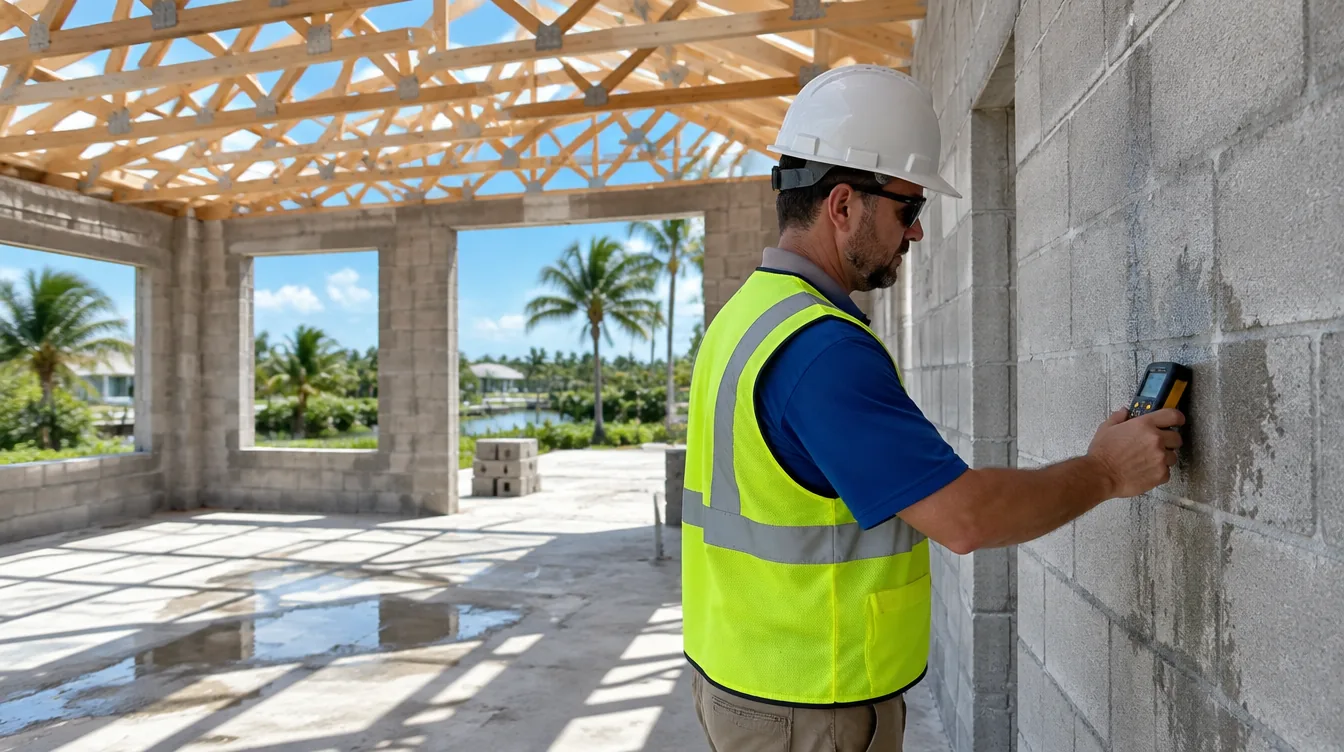
Why does mold show up in new construction in Florida?
Mold in new construction in Florida usually comes from moisture trapped during the build. Concrete block, slabs and framing can be soaked by summer storms before the roof and windows are in, drywall may be hung before materials dry, and finished homes often sit closed with little or no air conditioning before closing. Add Southwest Florida humidity and mold can start on drywall, trusses or cabinets before anyone moves in.
New doesn't always mean dry
Building in Southwest Florida means building through heavy rain for months of the year. Walls go up, sheathing and trusses get rained on, and a slab and block walls hold a lot of construction moisture. If the schedule moves faster than things dry, that water gets sealed behind drywall and under flooring. The house looks perfect at the walkthrough, and the first sign of trouble is a smell or a stain a few months later.
Sound familiar?
- Your new home smells musty and you've only lived there a few months.
- There are spots on the drywall inside closets or behind a door.
- Baseboards or cabinet bases look swollen or stained.
- The builder's answer was to wipe it down and repaint.
We do it differently.
| Common builder response | What actually resolves it | |
|---|---|---|
| Cause | Blamed on the homeowner's AC use | Moisture mapped to find where water was trapped |
| Visible spots | Wiped and repainted | Opened if readings show moisture behind |
| Attic | Not checked | Trusses and roof deck inspected |
| AC system | Assumed clean because it's new | Checked for construction dust, growth and drainage |
| Proof | Looks fine | Independent assessment and clearance testing |

Why families trust us with their homes
-
Family-owned since 2008
A multigenerational family business. Not a franchise, not a private-equity rollup.
-
Trained and certified
Our team holds IICRC, CMR, CRMI and CCMI credentials in mold remediation and inspection.
-
Called on as experts
Attorneys bring us into legal cases involving mold and mycotoxins.
-
Documentation at every step
Photos, moisture logs and lab reports you can hand to your insurer or FEMA.
- IICRC Certified Firm
- CMR
- CRMI
- CCMI
- BBB A+ Accredited
- NAMRI
- IAQA
- NORMI
- AMMA
- PMII
The AME Clearance Method
What to do if you find mold in a new Florida home
Steps that protect your home and your warranty conversations with the builder.
Talk to a specialist-
Photograph and date it
Take clear, dated photos of every spot, stain and damp area, and note when you first noticed each one.
-
Report it to the builder in writing
Follow the warranty's claim process exactly, and keep copies of every message. Ask what they plan to do and when.
-
Get an independent assessment
A licensed Florida mold assessor who doesn't work for the builder can document the extent and likely cause and write a scope.
-
Find the trapped moisture
Moisture readings in walls, slab edges, cabinets and the attic show whether water was built in or is still getting in.
-
Remediate to the scope
Remove what can't be saved, clean framing and block under containment, and correct the source before closing walls.
-
Confirm with clearance
Independent clearance testing gives you a record for the builder, your insurer and any future buyer.
Places to check in a newly built Florida home
- Roof trusses and the underside of the roof deck
- Drywall inside closets and behind doors
- Bottom of walls along the slab edge
- Under kitchen and bathroom cabinets
- Around windows and sliding glass doors
- The air handler, coil and drain pan
- Supply vents and return grilles
- Garage walls shared with the house
- Behind the washer and water heater
- Lanai doors and thresholds

Proof you can hold in your hands
When we finish, you don't get a handshake and a promise. You get the paperwork your family, your doctor, your insurer or your buyer can rely on.
Inspection report
What we found, where it is coming from, with color photos.
Written remediation plan
Scope, timeline and what will and won't be removed, before work starts.
Clearance lab report
Air, surface and mycotoxin results after the work is done.
A report for your doctor
With your permission, we share results directly with your care team.
New construction mold in Florida, explained
How water gets built into a new Florida home
Southwest Florida’s rainy season runs through the summer, and construction doesn’t stop for it. Between the day the block walls go up and the day the house is dried in, with the roof on and the windows set, framing, trusses and block can be rained on repeatedly. Concrete itself also carries water: a fresh slab and new block walls keep giving up moisture for some time as they harden and dry.
None of that is a problem if materials have time to dry before they’re covered. Trouble starts when the schedule doesn’t allow it:
- Drywall hung against damp block or framing
- Drywall delivered and stored where it got wet
- Flooring installed over a slab that hasn’t dried enough for the product
- Insulation packed into wet cavities
- A finished house held closed for weeks with the AC off or barely running
The last one matters most in a Florida summer. A sealed, unconditioned new house with drywall and cabinets inside is warm, humid and full of fresh food for mold.
Early signs in a new home
Mold in new construction often shows up in places nobody looks during a walkthrough: inside closets, on the back of cabinet toe kicks, on the attic side of the roof deck, and on the bottom edge of drywall along exterior walls. Other clues include a musty or earthy smell when the AC first kicks on, condensation on supply vents, and a home that never seems to get below a clammy humidity level. Our guide to humidity and mold in Florida homes explains why a new AC system doesn’t always keep humidity in check.
Working with your builder
Many new homes come with a builder warranty, and each warranty has its own process and deadlines. Report mold in writing through that process, include photos, and keep everything. Ask the builder how they’ll find the cause, not just what they’ll do about the visible spots. Wiping and repainting a stain without checking the wall behind it rarely ends the problem.
If a dispute develops, Florida has a pre-suit process for construction defects. Under s. 558.004, a claimant generally must serve written notice of the claim on the contractor at least 60 days before filing suit, or 120 days for an association representing more than 20 parcels. We’re not lawyers, and this is not legal advice. Talk to a Florida construction attorney about your warranty, your contract and any deadlines.
Why independent documentation matters here
With new construction, cause is everything. A builder may point to how the house has been lived in. An independent assessment, with moisture readings, sampling and a written report, gives you and the builder the same set of facts. In Florida, the law already expects that independence: under Florida Statute 468.8419, a company generally can’t assess and remediate the same structure within 12 months, apart from certified Division I contractors.
On our Southwest Florida projects, an independent licensed mold assessor inspects and samples the home, writes the scope, and performs clearance testing. We do the remediation to that protocol. For families concerned about toxins as well as visible growth, our national answer on whether a new house can have mycotoxins goes deeper.
Before you close
If you’re still in the building phase, ask how the builder protects materials from rain, whether the AC will run during finishing, and whether you can walk the house before drywall goes up. Take photos at every visit. If the house sat closed for a while before closing, a musty smell at the final walkthrough is worth taking seriously.
This guide is general information, not legal or medical advice. For questions about builder warranties or construction defect claims, speak with a Florida attorney. We remove mold and mycotoxins from buildings and don’t diagnose or treat medical conditions.
Common questions
Have a question that isn't here? Call a specialist
Is it normal to find mold in a new house in Florida?
It isn't unusual, but it isn't something to accept. It usually means materials got wet during construction and were closed in before they dried, or the house sat closed without enough air conditioning. Either way it's worth documenting and raising with the builder.
Should the builder fix mold in my new home?
That depends on your purchase contract, your warranty and the cause. Report it in writing through the warranty process. If the builder won't address it, talk to a Florida construction attorney about your options.
Can I get a mold inspection before closing on new construction?
Usually you can arrange inspections before closing, subject to your contract. If the home sat closed up, if you saw rain damage during the build, or if anything smells musty, adding an independent mold assessment is reasonable.
Can a new house have mycotoxins?
Yes. Some molds that grow on wet drywall and wood produce mycotoxins regardless of the building's age. If anyone in the household is sensitive, ask the assessor about mycotoxin sampling in addition to standard mold testing.
Why does my new home feel humid even with the AC on?
New homes can release construction moisture from slabs and block for months, and an AC that's oversized or not set up correctly may not remove enough humidity. A hygrometer and an HVAC check are good first steps.
What is a Chapter 558 notice?
Florida Statutes Chapter 558 sets a pre-suit process for construction defect claims. Generally, a homeowner must serve written notice on the contractor at least 60 days before filing suit. An attorney can tell you whether and how it applies to you.
We're done when the lab says so.
Every remediation ends with clearance testing, and our work is backed by a complete-removal guarantee. We don't close a job on a failed result.
Talk to a specialistMold in a home that's barely lived in?
Tell us what you're seeing and when the home was finished. A Southwest Florida specialist will call you back.
Not sure yet? Try the free AI Mold Risk Check