
Can you test for mold behind walls?
Short answer
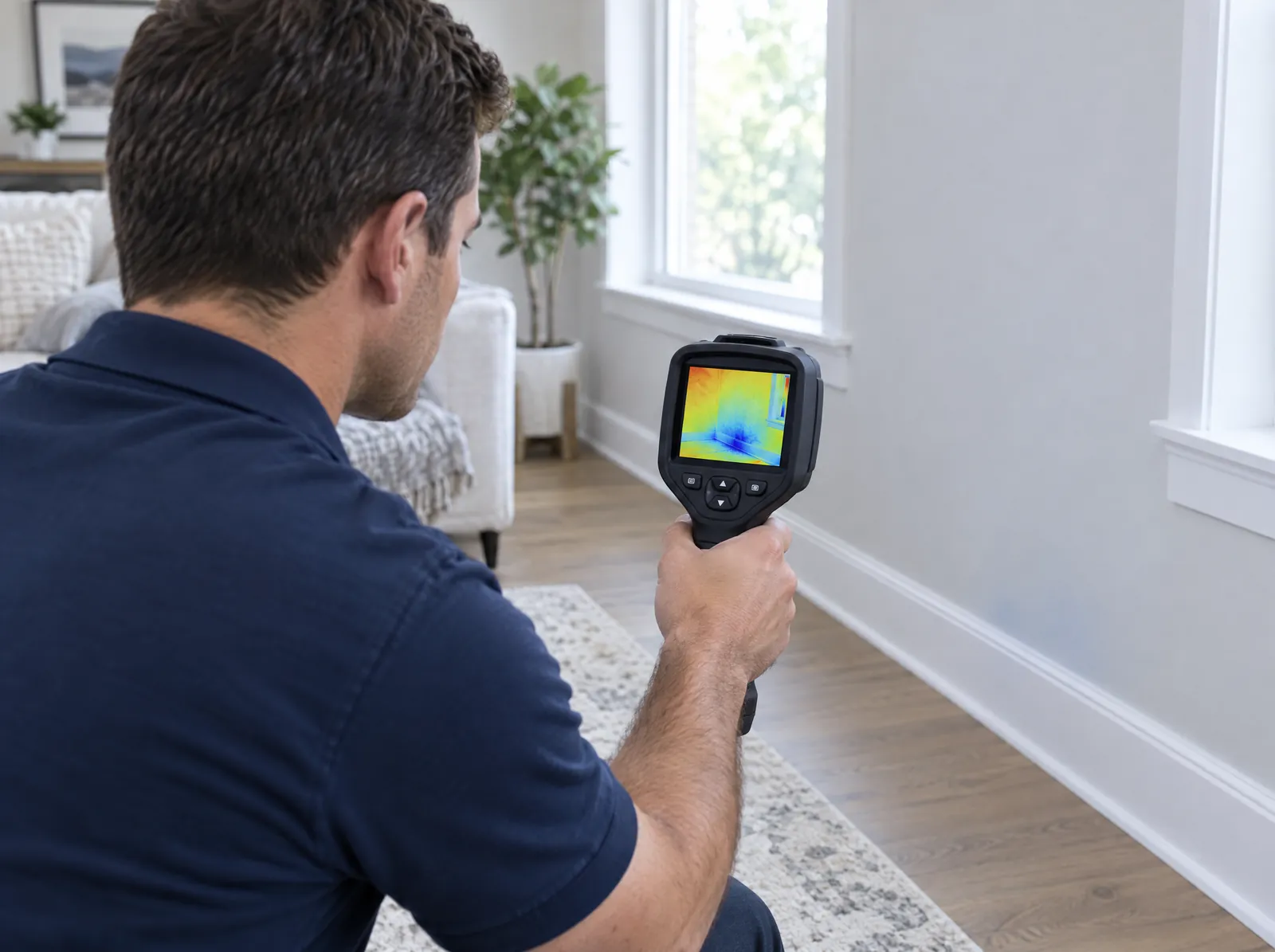
Yes. A professional can test for mold behind walls without tearing them open. Moisture meters and thermal imaging show where a wall is likely wet, and a wall cavity air sample, drawn through a small hole, tells the lab what's in the air inside the wall. The hole is patched afterward, and the results help decide whether any drywall actually needs to come out.
How a wall cavity sample is taken
- Pick the spot from the evidence. Moisture readings, thermal images, staining and odor decide which stud bay to sample. A random hole in a random wall rarely tells you much.
- Drill a small hole. Usually low on the wall, where water collects, or near the suspected source.
- Insert a sampling tube. The tube connects to a calibrated pump and a spore trap cassette.
- Draw a measured volume of air. The pump pulls air from inside the cavity through the cassette for a set time.
- Take comparison samples. Room air and outdoor air are sampled the same day, so the cavity result has something to be compared against.
- Seal the hole. The opening is plugged or patched when sampling is done.
Reading a wall cavity result
A wall cavity is not a living room. It’s dusty, closed off and full of construction debris, so a cavity sample isn’t expected to look exactly like outdoor air. What matters is the pattern. Molds associated with long-term water damage, such as Stachybotrys, Chaetomium or large amounts of Aspergillus and Penicillium, point to growth inside the wall. Hyphal fragments suggest mold is growing, not just spores that drifted in. A cavity result far above the room and outdoor samples, in a wall that also reads wet, is strong evidence.
A cavity sample is still a snapshot of one stud bay. A clean result in one bay doesn’t clear the whole wall, which is why the choice of location matters so much.
Other ways to look inside a wall
| Method | What it shows | How invasive |
|---|---|---|
| Thermal imaging | Cool or damp patterns on the wall surface | Not at all |
| Pinless moisture meter | Moisture just below the surface | Not at all |
| Borescope | A camera view of the cavity through a small hole | A small hole |
| Outlet or baseboard removal | A look at the bottom of the wall or inside a box opening | Minor, and easy to put back |
| Small inspection cut | A direct look at the back of the drywall and framing | A patchable opening |
These methods work together. Thermal imaging and moisture readings narrow the search, and a cavity sample or borescope confirms what the instruments suggest. The broader answer on whether a mold inspection can find hidden mold covers the full toolkit and its limits.
Why test before opening the wall
Cutting into a moldy wall without a plan releases spores and fragments into the house. If there’s significant growth inside, the opening should be made under containment, with negative air pressure and HEPA filtration, so the rest of the home stays clean. Testing first tells you whether that setup is needed, and how much of the wall is likely involved. It also avoids tearing out drywall that turns out to be fine. If removal is needed, mold in walls explains how we handle it.
What you can do yourself
Home kits can’t sample a wall cavity, and cutting into a suspect wall yourself risks spreading what’s inside. What you can do safely is look and note. Check the floor along the wall for staining or warped trim, feel for soft drywall, look for peeling paint or bubbling, and notice whether a smell is stronger near outlets on that wall. Write down what you find and when a leak may have happened. That history makes a professional’s sampling far more targeted.
We're done when the lab says so.
Every remediation ends with clearance testing, and our work is backed by a complete-removal guarantee. We don't close a job on a failed result.
Talk to a specialistWorried about a wall you can't see into?
Tell us which wall, what's on the other side, and what you've noticed. We'll plan moisture readings and cavity samples before anything gets cut.
- (833) 772-6653
- info@americanmoldexperts.com
- Open 7 days, 8am to 8pm