
Can a mold inspection find hidden mold?
Short answer
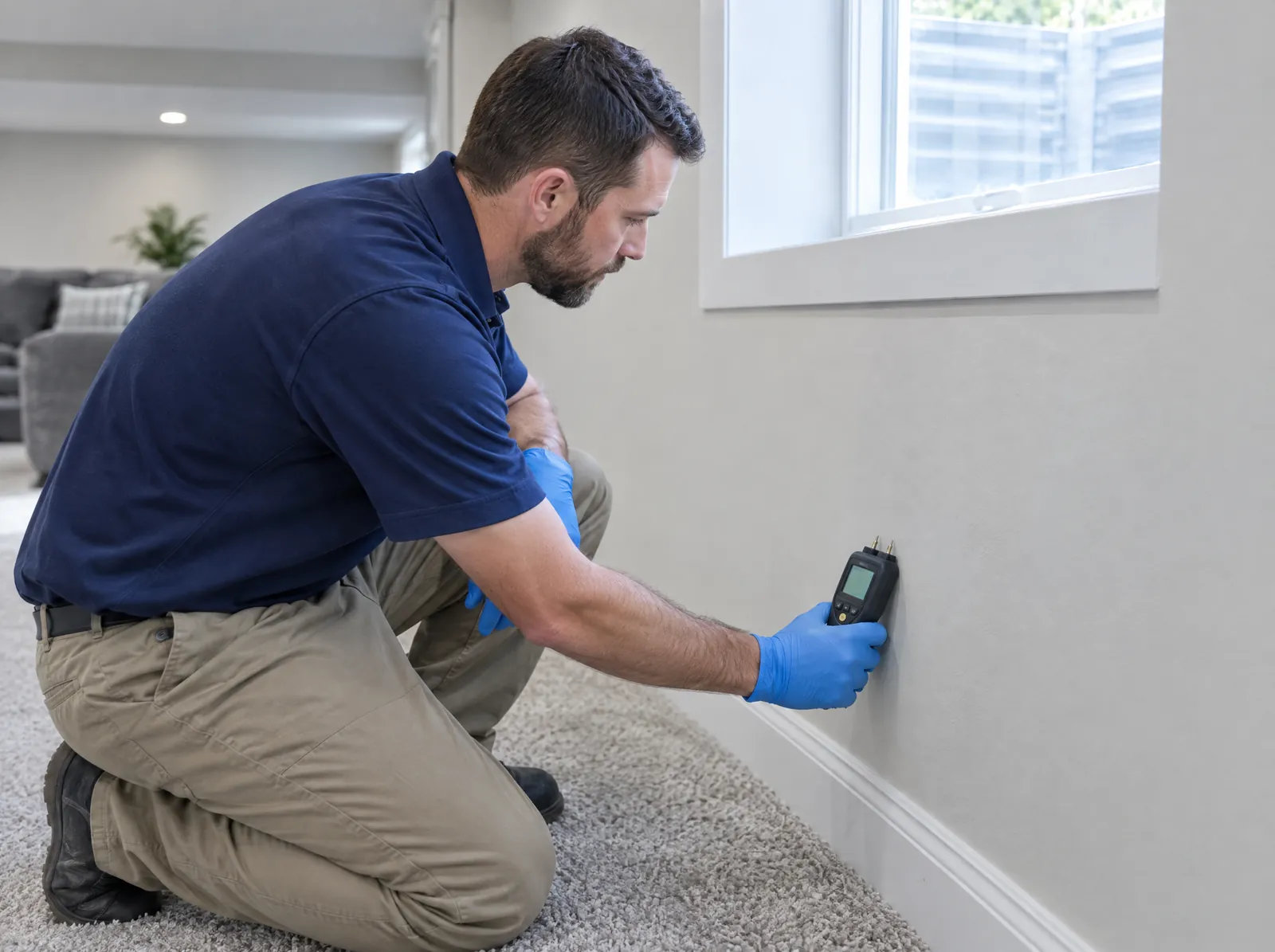
Yes, often, though no inspection sees through walls. A good inspector finds hidden mold by finding hidden moisture: moisture meters, thermal imaging, humidity readings and a musty odor point to the likely spots. Air samples from inside a wall cavity, or a small inspection opening, can then confirm growth before anyone removes drywall. Old growth that left no moisture clue can still be missed.
Where hidden mold usually grows
Mold needs moisture, something to eat and a little time. Building materials supply the food, so hidden growth shows up wherever water collects out of sight.
- Behind drywall on exterior walls, where condensation forms in cold weather
- Inside sink bases and behind dishwashers, refrigerators with water lines and washing machines
- Under vinyl flooring, laminate and carpet pad after a spill or slow leak
- Behind shower surrounds and tile with failed grout or caulk
- On attic roof sheathing, from roof leaks or poorly vented bathroom fans
- In crawlspaces and on basement walls behind finished framing
- Inside the HVAC air handler, drain pan and ductwork
The tools, and what each one actually detects
None of these instruments detects mold directly. Each one finds a different piece of evidence, and the inspector puts them together.
| Tool | What it detects | Limit |
|---|---|---|
| Pin moisture meter | Moisture in a specific spot, through two small pins | Reads only where it touches |
| Pinless moisture meter | Moisture a short depth below the surface, without marking it | Can be thrown off by metal, tile and dense materials |
| Thermal imaging camera | Temperature differences that can reveal damp or cold areas | Needs a temperature difference to work, and sees heat, not water |
| Hygrometer | Relative humidity in a room or cavity | Shows conditions, not growth |
| Borescope | A look inside a cavity through a small hole | Small field of view |
| Wall cavity air sample | Spores and fragments inside the wall | Needs a small hole; a snapshot like any air sample |
Why moisture is the trail
Hidden mold almost never shows up without a water story. A leak under an upstairs tub, a gutter that dumps against the foundation, a window that sweats every winter. When an inspector finds wet framing on a pinless meter and a cool patch on the thermal camera in the same spot, that’s where the sample goes. Season matters too. Condensation on exterior walls is easiest to spot with a thermal camera in cold weather, when the inside and outside temperatures are far apart, and a scan on a mild day may show very little. A careful inspector notes the conditions during the visit so the readings can be read in context. The National Institute for Occupational Safety and Health (NIOSH) has found that a careful visual inspection, or following a musty odor to its source, is often more reliable for finding mold problems than air sampling alone.
What an inspection can miss
Honest limits matter here. An inspection can miss growth from an old leak that has since dried completely, because the moisture clue is gone. It can miss areas nobody can safely reach, like a closed-off soffit or the space above a fixed ceiling. Heavy furniture and stored boxes hide walls. And sealed growth with no odor and no moisture can stay quiet. When the history strongly suggests a problem but the inspection comes up dry, a settled dust test such as ERMI or HERTSMI-2 can show whether water-damage molds have built up in the home over time.
When it makes sense to open the wall
Opening drywall is a decision to make after the evidence, not before. A small inspection hole or a wall cavity sample can confirm what’s there. If removal is needed, it should happen under containment so spores don’t spread to the rest of the house. Our page on mold in walls explains how that work is done.
We're done when the lab says so.
Every remediation ends with clearance testing, and our work is backed by a complete-removal guarantee. We don't close a job on a failed result.
Talk to a specialistThink something is growing out of sight?
Tell us about the smell, the stain or the leak history. We'll plan an inspection that traces the moisture before anything gets opened up.
- (833) 772-6653
- info@americanmoldexperts.com
- Open 7 days, 8am to 8pm