
Moisture Management in Southwest Florida
Mold is the problem people search for. Moisture is the problem underneath it — and until the moisture is managed, the mold story repeats.
Moisture management is American Mold Experts SWFL’s service for the cause, not just the symptom. We measure the moisture and humidity in your home, find where water and humid air are getting in, correct the sources, and then keep the home managed so the conditions mold needs never come back. AME does moisture management across Southwest Florida — Naples, Fort Myers, Bonita Springs, Estero, Cape Coral, and Marco Island — and it is the other half of the work behind our 4,500+ jobs: we contain it, destroy it, and make sure it does not return starts with keeping the home dry enough that there is nothing to return to.
Call AME SWFL: (239) 539-3997
Online: ameswfl.com
What Moisture Management Really Means
Moisture management is not a single repair. It is a sequence, and skipping a step is how homes end up remediated twice:
- Measure first. We inspect the whole home and take moisture readings in walls, floors, and ceilings, along with indoor humidity readings, to build a moisture map — where water has been, where it is active now, and where the home is at risk.
- Find the sources. A reading tells us where the moisture is; the inspection tells us why — a sweating duct, a failed shower pan, a clogged condensate line, humid air pulling into a crawl space or attic, or a home that sits closed with its humidity uncontrolled.
- Correct the sources. The building gets the repairs and installations that remove those conditions: encapsulation, insulation, sealing, and dehumidification, scoped to what your home actually needs.
- Keep it managed. A corrected home stays corrected when someone is watching the numbers. Our maintenance program and, for seasonal homes, our home watch keep humidity and moisture checked on a schedule instead of on a crisis.
If a quote you have been given treats the mold and never mentions the moisture, it is a cleanup quote. The growth may be gone; the reason it grew is still there.
Where Moisture Gets Into a Southwest Florida Home
- AC and condensate problems — In Southwest Florida your air conditioner runs most of the year. A clogged condensate drain, a sweating duct, or an air handler in a hot garage or attic can feed moisture into a home quietly for a whole summer.
- Closed-up seasonal homes — A home that sits shut for weeks with the AC off, set too high, or failed can reach mold-friendly humidity fast. This is the single most common moisture story we are called into in Naples and Bonita Springs.
- Roof and storm water — Daily June-to-October downpours find every weak flashing, cracked tile, and failed seal, and storm water that gets in and never fully dries stays in wall cavities and under flooring.
- Bathroom and shower failures — Original tile showers and tub surrounds eventually let water into the wall behind them. The tile can look fine while the wall board behind it stays wet.
- Attics and crawl spaces — Hot, humid air moves into attics and crawl spaces and condenses on cooler surfaces. Wet or fallen insulation holds that moisture against the structure.
- Block and slab construction — Concrete block and slab-on-grade floors can wick and transmit moisture, especially where coatings and seals have aged out.
Through all of it, the target is the same: we recommend keeping indoor humidity at 30–50% RH; above 50% is elevated RH, and 55% is the red line. A Southwest Florida home that lives above that line is a home managing a mold problem it has not met yet.
The Moisture Management Service, Part by Part
Moisture assessment & control. Every engagement starts with the assessment: a whole-home inspection, moisture mapping, and moisture and humidity readings, documented in writing. Where the findings call for mold or mycotoxin sampling, samples go to a lab — labs report results, and AME makes the findings from those results plus what we found in the home. There is no pass/fail in this work, and we will not pretend otherwise. You get the findings and a written scope and price before any correction work begins.
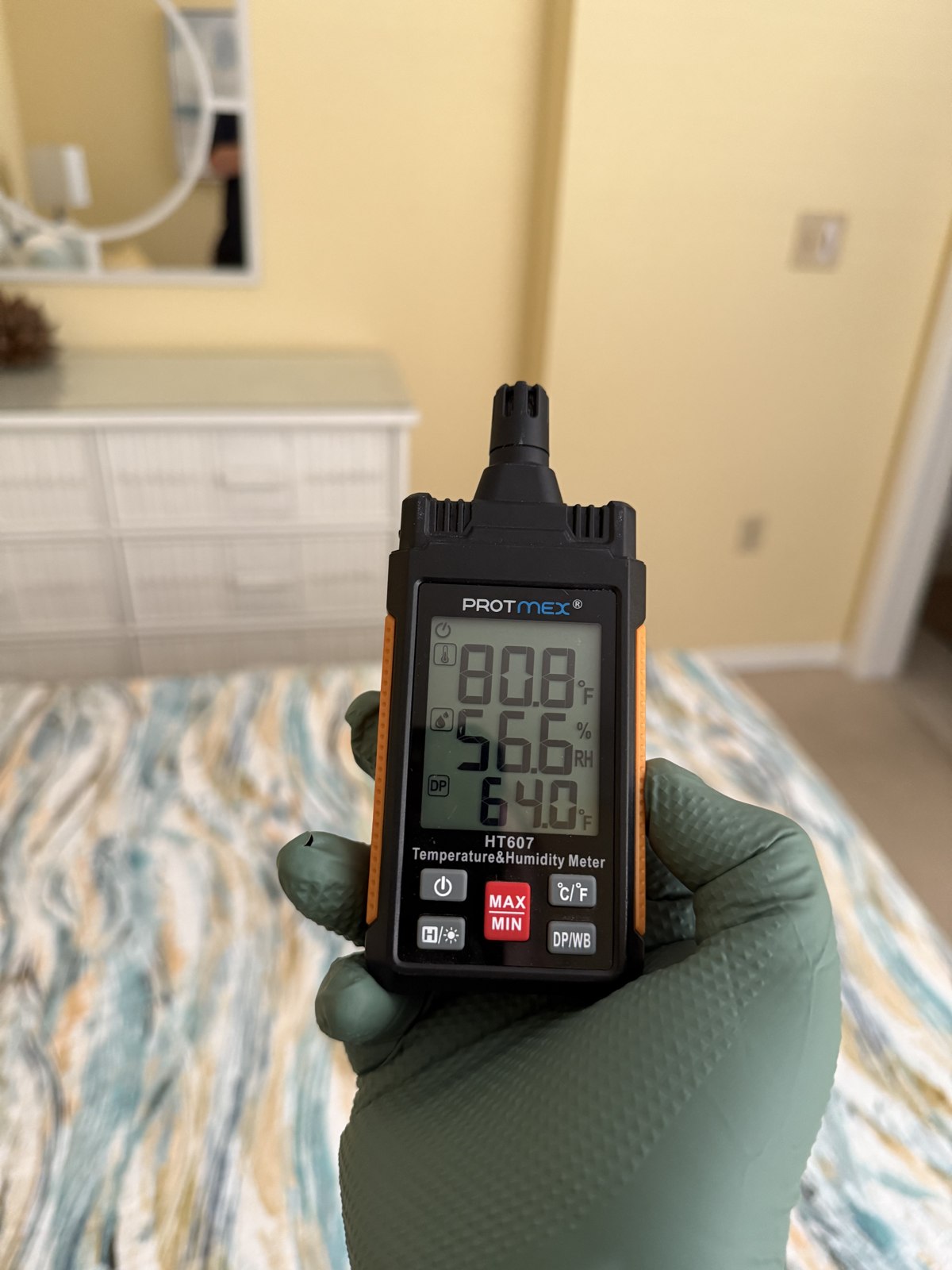
Moisture repairs. The repairs that remove the conditions the assessment found — the building-side work that stops water and humid air from getting where they do not belong, so the corrections that follow are built on a dry structure.
Crawl space encapsulation. For homes with a crawl space, encapsulation seals the space off from ground moisture and humid outside air with a vapor barrier and sealed vents and penetrations, so the underside of the home stops feeding moisture up into the floors and walls.
Rim joist & foundation insulation. The rim joist — where the home’s framing meets its foundation — is one of the most common places humid air enters and condenses. Insulating and sealing it closes a gap that runs the entire perimeter of the home.
Spray foam insulation. Spray foam insulates and air-seals in one application, used where the assessment shows it is the right tool — rooflines, rim joists, and other irregular spaces that batt insulation cannot seal properly.
Attic insulation — blow-in, removal & cleaning. Wet, contaminated, or settled insulation does not dry a home out; it holds moisture against it. We remove insulation that cannot stay, clean the attic space, and blow in new insulation to the proper depth.
Basement concrete & block sealing. Sealing concrete and block surfaces limits the moisture that migrates through them. In Southwest Florida construction this is mostly block wall and slab work — sealing the surfaces that wick moisture in from the ground and from humid air.
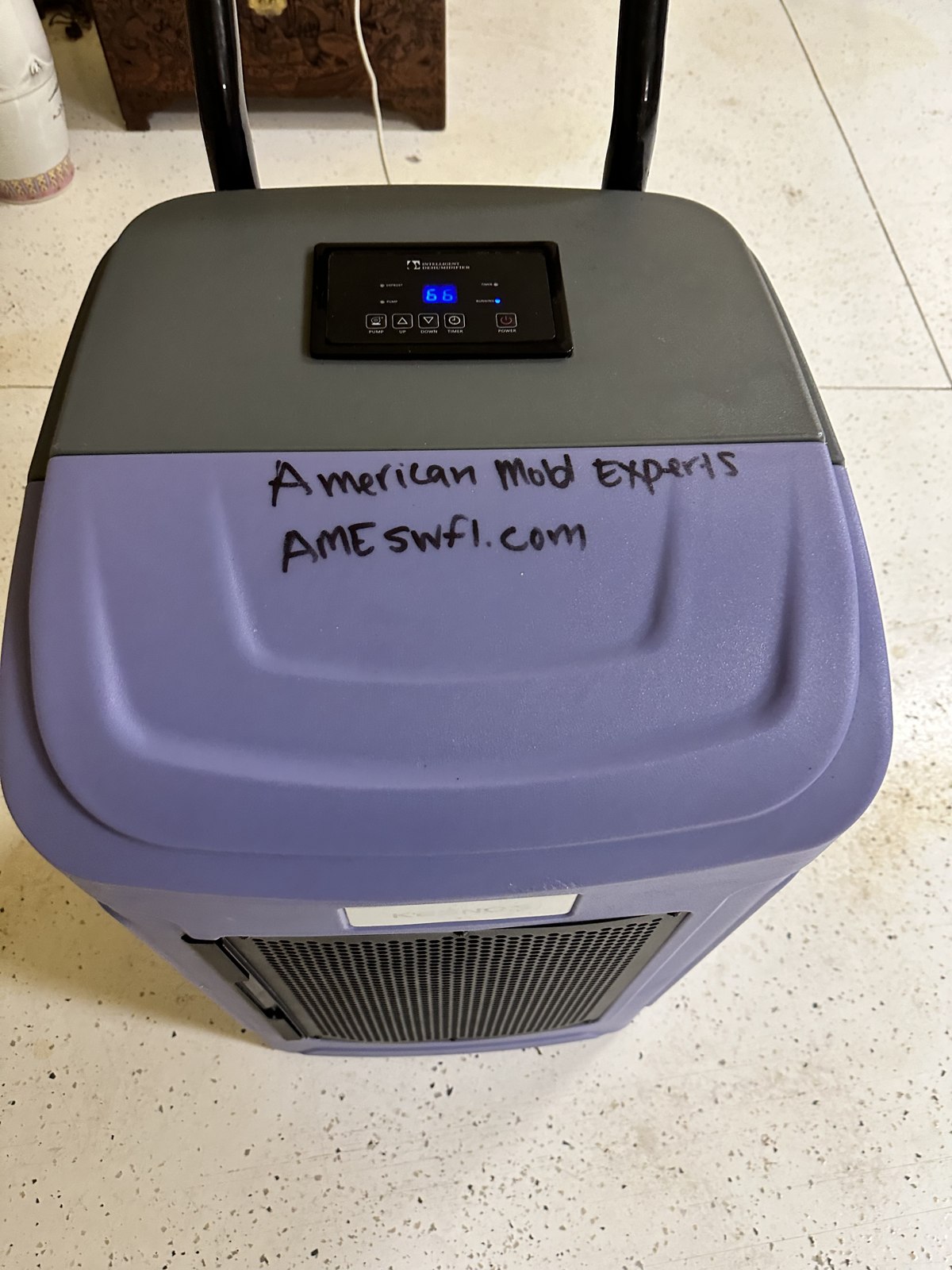
Dehumidification installation. Some homes cannot hold 30–50% RH on air conditioning alone — especially closed seasonal homes and homes with large glass and lanai exposure. A whole-home dehumidifier, sized to the home and tied into the HVAC system, holds the target range whether anyone is home or not — humidity control that runs on the home’s schedule, not the weather’s.
Duct repair & penetration sealing. Sweating, leaking ducts both waste cooling and drip moisture into attics and ceilings. We repair ductwork and seal the penetrations — the holes where pipes, wires, and ducts pass through the building shell — where humid air leaks in and condenses.
After the Fix: The Continued Maintenance Program
A correction is a moment in time. The Continued Maintenance Program is how the home stays managed after it:
- Quarterly mold inspections with humidity checks — visual inspection and moisture readings on a schedule, not on a suspicion.
- Monthly dehumidifier maintenance — the dehumidifier inspected, cleaned, and confirmed to be holding the home at 30–50% RH.
- HVAC coil & duct cleaning every 12–24 months, and annual vent cleaning.
- Air quality fogging with our non-toxic plant-based enzymatic treatment, up to three times a year or as needed.
- A written report after every visit — humidity readings by room, findings, and follow-up actions in writing.
We also leave hygrometers with our clients and recommend at least four in a home, including one in the attic — your own readings between our visits are the other half of keeping a home managed.
For Homes That Sit Empty: AME’s Home Watch
Seasonal homes are where moisture management matters most and gets watched least. AME’s home watch is built for them: scheduled weekly or bi-weekly visits to vacant and seasonal homes covering humidity monitoring, dehumidifier inspection, mold inspection, air quality evaluation, and an HVAC performance check, with a photo-documented written report after every visit.
The difference is who is doing the watching. A conventional home watch checks that a house is standing and its systems are on. AME’s home watch is run by certified mold professionals, so the visit reads the home the way an assessor would: room-by-room humidity readings against the 30–50% target, moisture checks where problems start, preventive cleaning where it is needed, and small airflow and setup problems corrected on the spot. In the pilot home we watch in Naples, one visit’s report ran 17 pages with 59 photos — humidity readings room by room, duct covers cleaned, a bed moved off a wall to correct airflow. If a visit finds a real problem, it is documented while it is still small, and AME can scope the fix before a season of humidity turns it into a remediation.
Moisture Is the Cause Under the Mold
Everything AME does starts from one fact: mold is a moisture problem with a visible symptom. Killing mold is not the same as removing what it leaves behind, and removing mold is not the same as removing the moisture that grew it. That is why our remediation process fixes the water first — and why this service exists for homes that have not had a mold problem yet, or have had one and never want another.
It is also why we look at the whole home. The part you cannot see — bacteria, spores, mycotoxins — does not stay in one room, and moisture does not either: the crawl space feeds the first floor, the attic feeds the ceiling, the AC feeds every room. A flashlight in an attic or closet only shows where to look; it cannot confirm mold, and it cannot measure moisture. Readings can. If the bigger question is whether the home itself is the problem, read is my home making me sick?
Who You Are Hiring
AME is led by Scott Allen Briggs, President and Owner, and Leigh Ann Briggs, Partner and Owner. Scott is a Florida Licensed Mold Assessor (MRSA) and Florida Licensed Mold Remediator, License MRSR4824. With 4,500+ jobs completed, AME is known as the Gold Standard in mold removal in Southwest Florida — licensed, documented, and built around doing the unglamorous parts of the job properly: moisture, containment, contents, and paperwork.
One role per project: AME SWFL holds both Florida licenses — Mold Assessor (MRSA) and Mold Remediator (MRSR4824) — but on any given project we take only one role: we assess and test, or we remediate. The other side is handled by an independent licensee, and remediation is verified by independent clearance testing.
Read what Southwest Florida clients have said about working with us: AME SWFL Google reviews.
What Moisture Management Does Not Do
We would rather tell you this up front: moisture management addresses the moisture conditions in your home. It is not a medical treatment, and we make no promises about anyone’s health or symptoms. It is also not a substitute for remediation where mold growth already exists — managing moisture stops the cause, and existing growth still has to be removed properly. If you have health concerns, see your doctor — and then let us take the building problem off your list, with documentation you can keep for your records, your insurer, or a future sale.
A Note From the Owner
I’m Scott Allen Briggs, president and owner of AME — and I’ve been where you are. I moved to Florida in 2022, the year Hurricane Ian hit, and rebuilt my own condo with new cabinets and flooring. I’ve also lived through mold toxicity myself. That experience is why AME treats moisture as the main event instead of an afterthought: across 4,500+ jobs, the homes that stay clean are the homes whose moisture got managed. My standing rule says it plainly: “Common should never be mistaken as safe.”
Frequently Asked Questions — Moisture Management in Southwest Florida
How much does moisture management cost in Southwest Florida?
It depends on what the assessment finds — a home that needs a dehumidifier and duct sealing is a very different job from one that needs encapsulation, insulation removal, and a maintenance program. What we promise is the sequence: assessment and findings first, then a written scope and price before any correction work begins, so you can compare it line by line with any other quote you get. Call (239) 539-3997 to schedule an assessment.
What does a moisture assessment actually involve?
A whole-home inspection with moisture readings in walls, floors, and ceilings, plus indoor humidity readings — a moisture map of where water has been, where it is active, and where the home is at risk. Where the findings call for it, mold or mycotoxin samples go to a lab, the lab reports its results, and AME makes the findings. A flashlight in an attic or closet only shows where to look; it cannot confirm mold, and it cannot measure moisture. Readings can.
My home already has mold. Do I start with moisture management or remediation?
They are two halves of the same job, and the order matters: remediation removes the growth and what it left behind, and moisture management removes the conditions that grew it. AME scopes both from the same findings, so the moisture source is fixed as part of the plan — remediation scheduled before the moisture is addressed is remediation you will pay for twice.
How do I know if my home’s humidity is too high?
By the numbers: we recommend keeping indoor humidity at 30–50% RH. Above 50% is elevated RH, and 55% is the red line — a home living above it is giving mold what it needs. An inexpensive hygrometer tells you where a room sits; we leave hygrometers with our clients and recommend at least four in a home, including one in the attic. If your readings live above 50%, that is a moisture management conversation, not a wait-and-see.
What is the Continued Maintenance Program, and do I need it after the work?
It is the scheduled care that keeps a corrected home corrected: quarterly mold inspections with humidity checks, monthly dehumidifier maintenance, HVAC coil and duct cleaning every 12–24 months, annual vent cleaning, and air quality fogging with our enzymatic treatment up to three times a year — with a written report after every visit. Not every home needs it. Homes with a mold history, homes that sit closed for part of the year, and homes whose humidity runs high are the ones it is built for, and we will tell you honestly whether yours is one of them.
My home sits empty for part of the year. How does the home watch work?
AME’s home watch visits your vacant or seasonal home weekly or bi-weekly while you are away: humidity monitoring, dehumidifier inspection, mold inspection, air quality evaluation, and an HVAC performance check, with a photo-documented written report after every visit. Because the visits are done by certified mold professionals, a problem gets caught at the reading stage — humidity climbing, a dehumidifier down, moisture where it should not be — instead of at the remediation stage when you come home to it.
What if I find mold or water damage after hours?
For a true emergency — active water intrusion, a burst pipe, flooding — call (239) 539-3997 any time: in Southwest Florida we’re open 24 hours, emergency calls are answered live, and we respond to true emergencies. If water is actively flowing, shut it off at the main valve if you can do so safely, and keep clear of any area where water is near electrical outlets or the panel. Non-emergency calls are welcome any time too — if we miss you, leave a message and we will get back to you.
Is the treatment safe for my air and ducts?
Yes. The enzymatic treatment AME uses is non-toxic and plant-based, made for virtually all materials and surfaces — and it is safe for the air system, including ductwork, coils, and the air handler, which is why contamination inside the HVAC system itself can be treated, not just worked around. It is also safe for homes with people and pets. During the work itself, occupants and pets stay out of the remediation area until AME releases the home.
What does the treatment remove?
The enzymatic treatment works on mold, mycotoxins, spores, VOCs, and bacteria — including gram-negative bacteria — and it is tested and proven. It can be fogged to treat the air itself, applied to surfaces, and used on contents and personal belongings — the things most traditional companies would tell you to throw away. That is the heart of AME’s contents cleaning: fine-particle cleaning with an enzymatic treatment, built for sensitive homes and the people in them.
Doesn’t an air scrubber take care of the mycotoxins?
Not by itself. Air scrubbing and HEPA filtration capture particles from the air while the machines run, and AME uses them — but they do not clean mycotoxins off surfaces, dust, and belongings. Worse, the agitation can strip mycotoxins off the spores and put them back into the air. If fine-particle cleaning with a proven treatment isn’t done, the mycotoxins will most certainly still be left behind. That is why AME’s process pairs containment and HEPA filtration with fine-particle cleaning and enzymatic treatment of surfaces and contents — and then verifies.
Will you check the rest of my home, or just the wet area?
The whole home. AME looks at a home as a whole rather than as sections of water damage, because the part you can’t see — bacteria, spores, mycotoxins — doesn’t stay in one room. And honestly, the area we were called for is not always the worst one: there may very well be other parts of the home that are worse than the problem we are there for, including areas an insurance claim may not cover. We would rather show you the full picture and let you decide than fix one section and leave a worse one hidden.
Schedule a Moisture Assessment in Southwest Florida
Moisture problems do not stay the size you found them. The earlier a home’s moisture is measured and managed, the smaller the job stays — and the less likely it ever becomes a mold job at all. Start with the assessment. If mold is already growing, mold remediation in Fort Myers is where most Lee County homeowners start, and for testing in our home market, see mold testing in Naples.
American Mold Experts SWFL
Call: (239) 539-3997
Web: ameswfl.com
Reviews: Read or leave a Google review
Tell us what's going on
A mold specialist will call you back.
Not sure yet? Try the free AI Mold Risk Check