
Should I leave my AC on when I leave my Florida home?
Short answer
Yes. In Southwest Florida, turning the air conditioning off while you're away lets indoor humidity climb, and a closed-up house with no air moving is exactly where mold grows. FPL suggests about 80°F for short trips and 82°F for longer ones, and around 78 to 82°F for seasonal residents, keeping humidity below 60 percent. Leave the fan on AUTO.
Why switching it off backfires
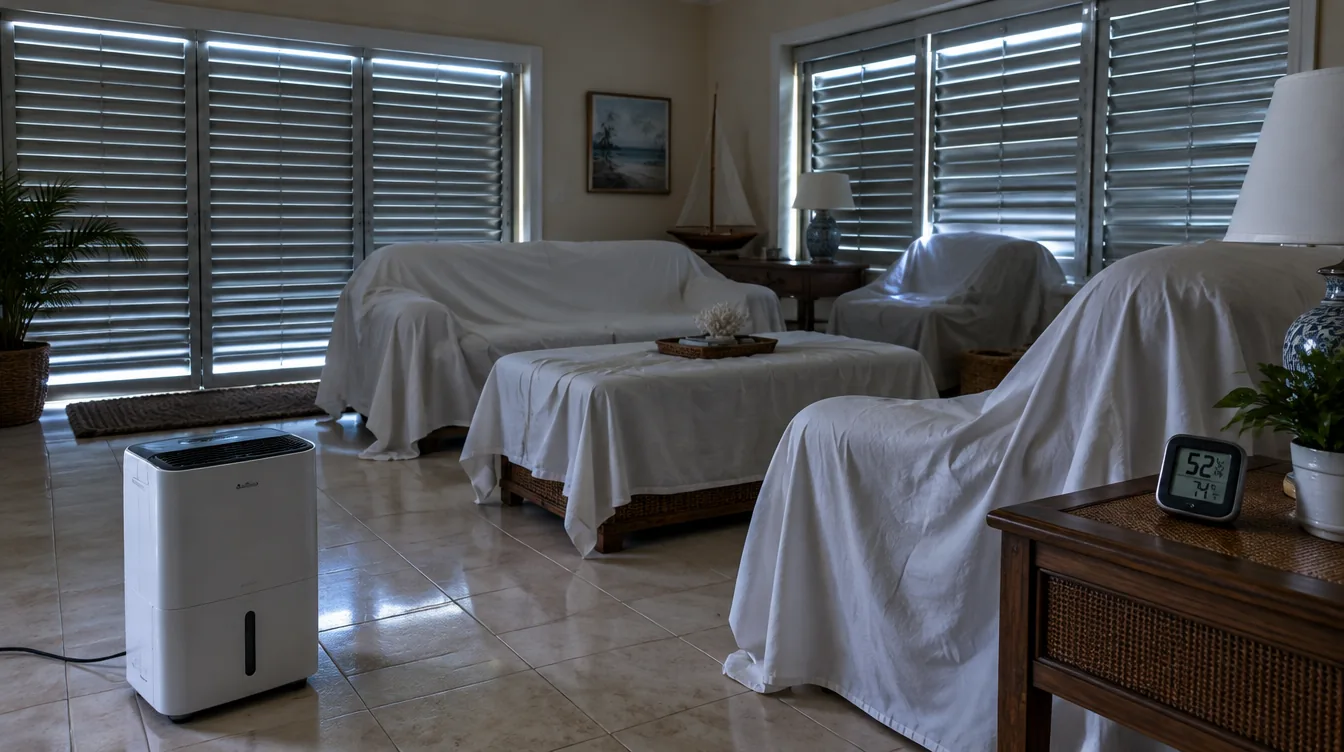
Turning the AC off feels like the thrifty move when nobody is home. In Southwest Florida it’s usually the expensive one. Your air conditioner isn’t only cooling the house; it’s drying it. With the system off, the humid outdoor air that leaks in through doors, windows and walls has nowhere to go. Indoor humidity rises, and it stays high in the places air doesn’t move: closets, cabinets, the space behind furniture and the AC closet itself.
That’s how people come back in the fall to mildew on leather shoes and handbags, a white film on wood furniture, spots on closet walls and a musty smell that hits at the front door. It rarely takes a leak. Humidity alone is enough in a closed Florida house over a summer.
What to set it to
FPL’s guidance for time away:
- A few days: about 80°F
- A longer vacation: about 82°F
- Seasonal residents away for months: around 78 to 82°F, with humidity kept below 60 percent
Two settings matter as much as the temperature. Put the thermostat fan on AUTO, not ON. The Florida Solar Energy Center explains that a fan running after the compressor stops blows moisture from the wet coil back into the house. And if your thermostat has a humidity or dehumidify setting, use it. For how these numbers work when you’re living in the house, see what temperature to set your AC to prevent mold.
The Florida Solar Energy Center also describes two approaches for vacant homes: running a dehumidifier on a timer for a few hours a day, or programming the thermostat to cool the house for a few hours overnight and hold a higher setting the rest of the day. Either way, the goal is the same: keep humidity down, not the temperature.
A checklist before you close up for the season
- Have the AC serviced, including the coil, drain pan and condensate line. A clogged line while you’re away can mean water on the floor and a wet wall for months.
- Put in a fresh filter.
- Leave interior doors and closet doors open so conditioned air reaches every room.
- Place a Wi-Fi temperature and humidity sensor in the house so you can watch readings from wherever you are.
- Empty the refrigerator if you’re turning it off, and prop the door open.
- Ask someone to check the house regularly, and especially after any storm or power outage.
- If you close hurricane shutters, remember they cut off light and air movement too. Our page on whether hurricane shutters can cause mold explains what to watch.
But isn’t it cheaper to turn it off?
For a weekend away, the savings from turning the system off are small, and FPL’s own guidance is to raise the setting rather than switch it off. For a summer away, the math tilts further against it. Cleaning mildew off furniture, replacing clothing and shoes, and removing mold from closet walls or the AC system costs far more than a few months of running the system at a higher setting. There’s also the house itself: drywall, cabinets and wood trim all hold up better when humidity stays steady.
Condo owners have one more reason to leave it on. A water problem in one unit, such as an AC drain line that overflows while nobody is home, can reach the units beside and below it. Check your association’s rules and your condo documents for what’s expected of absent owners.
The storm problem
Southwest Florida’s seasonal residents are usually away during hurricane season, which runs through November. A storm that knocks out power for a week shuts off the AC with nobody there to notice, and it may not restart cleanly when power returns. A house watcher, or a sensor that alerts you when the power or humidity changes, is worth more than any thermostat setting.
If you come home to a musty house
Open up the house only if the outdoor air is drier than the indoor air, which in a Florida summer it usually isn’t. Get the AC and a dehumidifier running, and don’t just wipe visible spots and move on. Growth on contents often means growth in the AC system or on closet walls too. Our seasonal home mold service is built for this. An independent licensed mold assessor inspects and samples the home, writes the scope and performs clearance testing, and we do the remediation to that protocol, including cleaning contents and the AC system where needed.
We're done when the lab says so.
Every remediation ends with clearance testing, and our work is backed by a complete-removal guarantee. We don't close a job on a failed result.
Talk to a specialistComing back to a musty house?
Tell us how long the home was closed and what you're noticing. A Southwest Florida specialist will call you back.
Not sure yet? Try the free AI Mold Risk Check