
Can hurricane shutters cause mold?
Short answer
Not by themselves. Shutters don't create moisture, but a house sealed up behind them can grow mold if the power goes out and the AC stops, if rain gets trapped between the shutter and the window, or if the house stays closed for weeks. Keep humidity under control while they're up, and check window sills and frames when they come down.
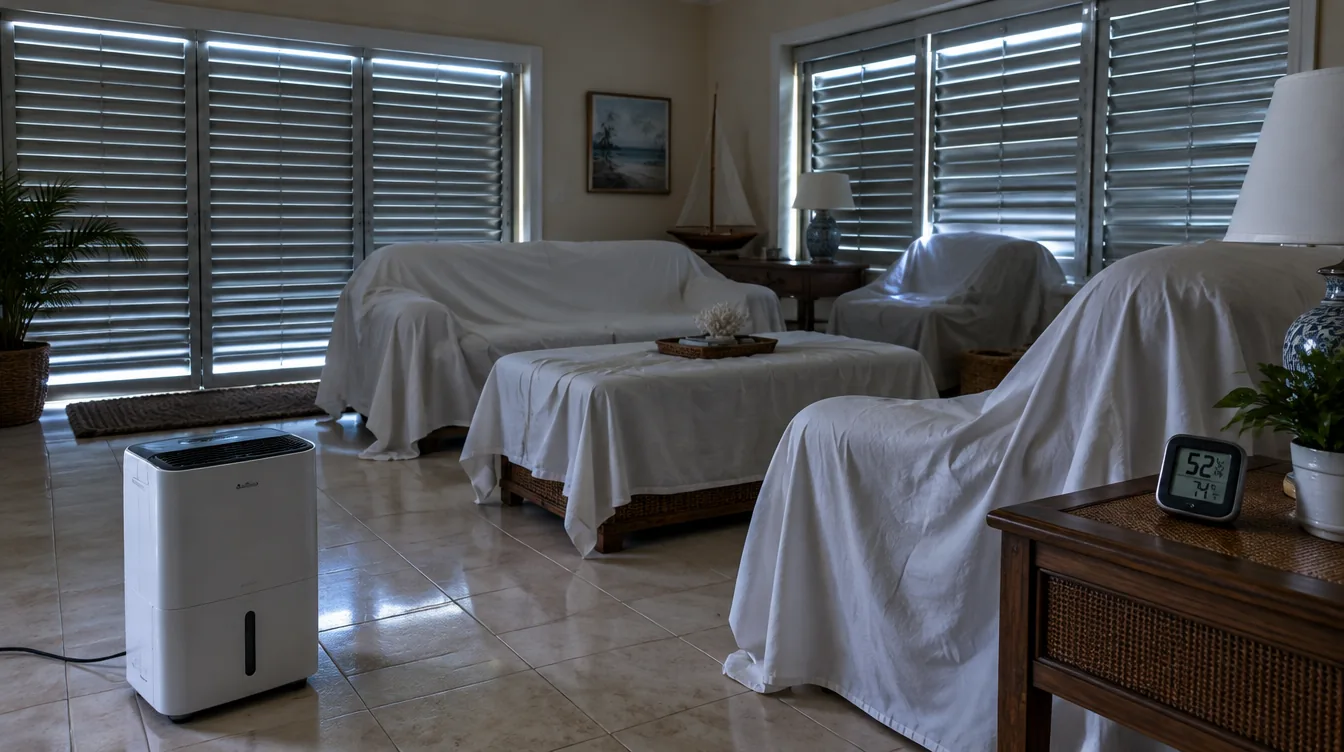
What shutters change inside the house
Hurricane shutters do their job by closing the house off. Panels, accordions and roll-downs cover the glass, block most daylight and keep windows from being opened. That’s fine for a few days with the power on and the AC running. The trouble starts when one of three things happens:
- The power goes out. Without air conditioning, a sealed Florida house heats up and humidity climbs, with no way to air it out.
- The shutters stay up for weeks. Seasonal owners sometimes leave them up all summer, which means nobody sees or smells a problem until fall.
- Water gets in behind them. Wind-driven rain can collect between the shutter and the window, on sills and in tracks, and sit there without sun or airflow to dry it.
In each case, the shutters aren’t the source of the water. They just make it harder for the house to dry and harder for you to notice.
Where moisture collects
- Window sills and the bottom of window frames, especially on the sides of the house that face the weather
- Slider and window tracks, where water pools and debris holds it
- The wall and stucco around shutter tracks and mounting points, if the seal around them has failed
- Interior window sills and the drywall below them, where condensation can form on cool glass
- Stored storm panels or fabric screens that were put away wet
What to check when the shutters come down
- Take them down as soon as it’s safe after the storm, and let the sun and air reach the windows.
- Wipe and dry sills, frames and tracks. Look for dark spots, peeling paint or soft caulk.
- Walk the house and smell. A musty smell in one room often points to a window or wall that took water.
- Check the drywall below windows and in closets on exterior walls. Our page on mold on window sills covers what small surface spots mean.
- Make sure panels and fabric screens are dry before you store them.
- If the power was out for more than a day or two, check the AC closet and the air handler before the system runs full time.
If you’re leaving the house shuttered
For owners who leave for the summer with shutters up, humidity control matters more than anything else. Keeping the AC running at a reasonable setting, or running a dehumidifier that drains on its own, keeps the house from turning into a closed, humid box. Our guides on whether to leave the AC on when you leave your Florida home and what temperature to set the AC to prevent mold go into the settings.
A few other habits help: have someone check the house after every storm and power outage, clear the AC condensate line before you leave, and ask your house watcher to open a door and smell. Nose checks catch a lot.
Hurricane season is long
Atlantic hurricane season runs from June 1 to November 30, and in some years Southwest Florida puts shutters up more than once. In 2024, Helene and Milton came about two weeks apart, close enough that shutters taken down after one storm could be going back up for the next. Each cycle is another chance for water to sit behind a panel, so check again every time.
Do shutters themselves grow mold?
Metal and polycarbonate panels don’t feed mold, but dirt and pollen on them can support a film of mildew if they’re stored damp in a hot garage or shed. Fabric storm screens are more prone to it. Rinse panels and screens, let them dry fully in the sun, and store them off the floor. That growth is a cleaning job, not a sign of a problem inside the house, but it’s a good reason not to bring damp panels into living space.
When it’s more than a wet sill
Surface spots on a sill can usually be cleaned once the water is gone. A smell that won’t clear, stains spreading on the drywall, or growth in several rooms is different. That usually means water got into a wall or the AC system. Our seasonal home mold service is built for homes that sat closed, and our free AI Mold Risk Check can help you decide what to do next. If testing is needed, it’s done by an independent licensed mold assessor.
We're done when the lab says so.
Every remediation ends with clearance testing, and our work is backed by a complete-removal guarantee. We don't close a job on a failed result.
Talk to a specialistMusty smell after the shutters came down?
Tell us how long the house was closed and what you're seeing. A Southwest Florida specialist will call you back.
Not sure yet? Try the free AI Mold Risk Check