
Southwest Florida black mold
Black mold removal in Southwest Florida
Not every dark stain in a Florida home is black mold. We remove what the lab confirms, safely and completely.
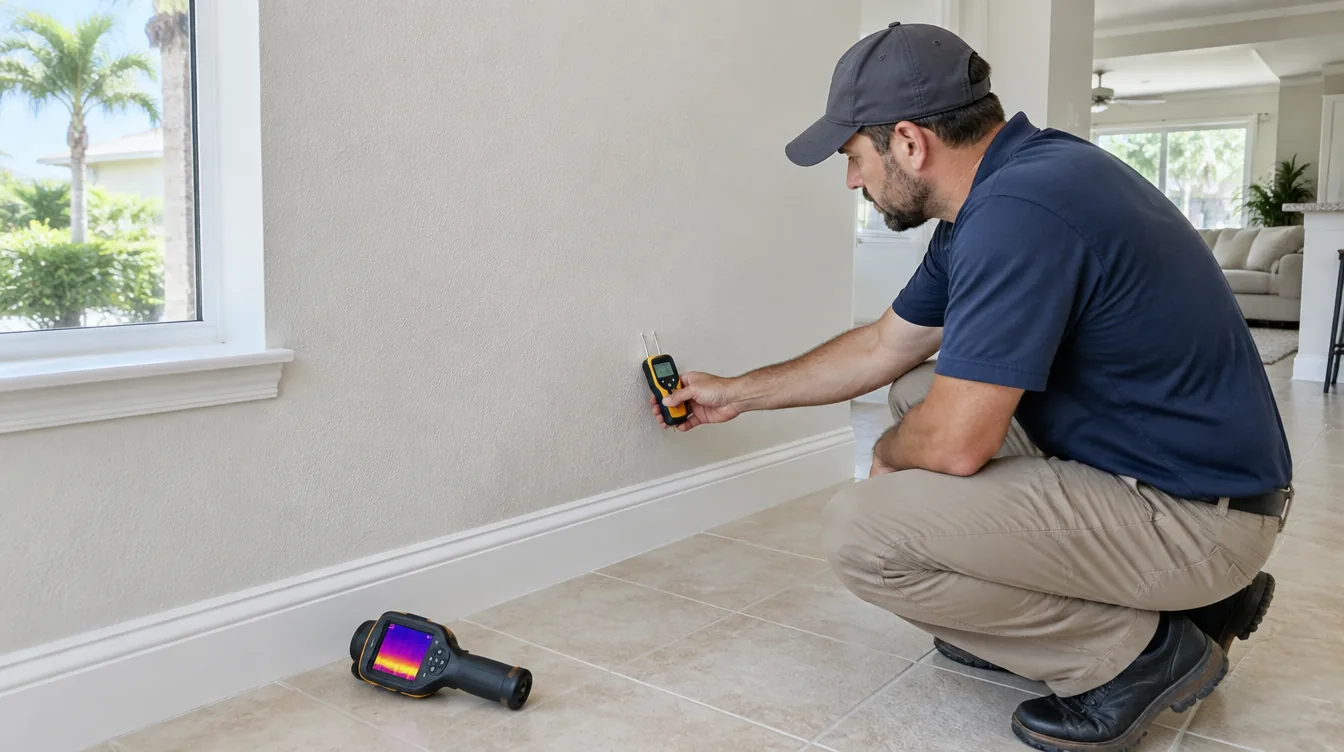
What does black mold removal in Southwest Florida involve?
Black mold removal in Southwest Florida means cutting out dark mold growth, most often Stachybotrys chartarum, together with the wet drywall or wood it is growing in, under containment. In Florida homes it usually turns up after storm water, a long plumbing leak or a failing AC drain. Color alone can't identify it, so an independent licensed assessor samples first. We remove what the scope calls for, then the assessor confirms clearance.
Why "black mold" is confusing in Florida
In a humid climate, dark spots show up everywhere: on AC vents, grout, window tracks, lanai ceilings and the north side of a stucco wall. Most of it isn't Stachybotrys. True Stachybotrys needs material that has stayed wet for a long time, like the paper on drywall behind a leaking cabinet or the bottom of a wall that sat in flood water. That difference changes the whole job, which is why guessing by color leads people to either panic over nothing or paint over something serious.
Sound familiar?
- You found dark growth low on a wall after the storm and don't know what it is.
- A handyman offered to bleach it and paint over it.
- The spots on your AC vents keep coming back after you wipe them.
- You've read about toxic black mold and are worried about your family.
We do it differently.
| Bleach and paint | AME black mold removal | |
|---|---|---|
| Identification | Guessed by color | Sampled and lab-identified by an independent assessor |
| Water source | Not investigated | Leak, AC drain or storm damage found and corrected |
| Moldy drywall | Bleached and painted | Cut out and bagged under containment |
| Wall cavity and block | Left as is | HEPA cleaned and enzyme treated |
| Proof | It looks clean | Independent clearance testing |

Why families trust us with their homes
-
Family-owned since 2008
A multigenerational family business. Not a franchise, not a private-equity rollup.
-
Trained and certified
Our team holds IICRC, CMR, CRMI and CCMI credentials in mold remediation and inspection.
-
Called on as experts
Attorneys bring us into legal cases involving mold and mycotoxins.
-
Documentation at every step
Photos, moisture logs and lab reports you can hand to your insurer or FEMA.
- IICRC Certified Firm
- CMR
- CRMI
- CCMI
- BBB A+ Accredited
- NAMRI
- IAQA
- NORMI
- AMMA
- PMII
The AME Clearance Method
How we remove black mold, step by step
Seven steps, in this order. Stachybotrys has to be disturbed as little as possible until the area is sealed off.
Talk to a specialist-
Independent identification
A licensed Florida mold assessor, independent of us, samples the growth and the air and writes the scope. Now you know what you are dealing with.
-
Trace the water
Stachybotrys means something stayed wet. We find it: a supply line, a shower pan, an AC drain, a window, a roof leak or old storm water in the wall.
-
Seal it off first
Plastic containment and negative air go up before anything is cut, so spores and fragments stay inside the work area.
-
Cut out the wet material
Affected drywall, baseboard, cabinet backs and insulation are removed in whole sections and bagged inside containment.
-
Clean the block and framing
HEPA vacuuming and detailed cleaning of the block, studs and slab, then plant-based enzyme treatment of the cavity.
-
Scrub the air
Air scrubbers run through the job, and the rest of the house gets HEPA cleaning where dust may have traveled.
-
Independent clearance
The assessor retests before the wall is closed. The rebuild waits for a passing result.
What every black mold job includes
- Lab identification by an independent licensed assessor
- A written scope before any demolition
- Moisture source investigation
- Containment with negative air
- Removal of affected drywall and porous materials
- HEPA cleaning of block, framing and slab
- Enzyme treatment of the wall cavity
- Air scrubbing during the work
- Photo documentation of every stage
- Independent clearance before rebuild

Proof you can hold in your hands
When we finish, you don't get a handshake and a promise. You get the paperwork your family, your doctor, your insurer or your buyer can rely on.
Inspection report
What we found, where it is coming from, with color photos.
Written remediation plan
Scope, timeline and what will and won't be removed, before work starts.
Clearance lab report
Air, surface and mycotoxin results after the work is done.
A report for your doctor
With your permission, we share results directly with your care team.
Black mold in Florida homes, explained
Dark growth in Florida homes, and what it usually is
The CDC lists Cladosporium, Penicillium and Aspergillus as the most common indoor molds, and several of them can look dark or nearly black. Color says very little about which mold you have. Location and moisture history say a lot more. Here is how we think about the dark growth homeowners call us about most in Southwest Florida:
| Where you see it | What’s usually behind it | How likely it is to be Stachybotrys |
|---|---|---|
| Around AC supply vents | Cold air meeting humid room air, plus dust | Low, but worth checking the AC system |
| Shower grout and window tracks | Everyday surface moisture | Low, usually a cleaning issue |
| Lanai ceilings and stucco outside | Mildew and algae on exterior surfaces | Low, and not an indoor air problem |
| Low on drywall after a storm | Flood water or surge soaked the wall | Real possibility, sample before touching it |
| Inside a sink cabinet or behind a toilet | A slow leak that stayed wet for weeks | Real possibility |
| Behind furniture on an exterior wall | Moisture from the block and poor air movement | Possible, depends on how long it has been wet |
The table is a starting point, not a diagnosis. Only a lab can tell you what the growth is, and in Florida that sampling is the assessor’s job.
Why Stachybotrys follows storms and hidden leaks
Stachybotrys chartarum is a slow grower. It needs cellulose, like drywall paper, cardboard or wood, that has stayed wet for a long time. That is why it so often shows up in Southwest Florida after surge or flood water, as happened across the region after Hurricane Ian in 2022 and Helene and Milton in 2024. Walls were soaked, the power was out for days, and some drywall was dried on the surface and left in place.
The other common source is a leak nobody could see: a supply line behind a vanity, a shower pan, a window that lets in wind-driven rain, or an AC drain pan that overflowed inside a closet. Because Florida walls are usually drywall over concrete block, the moisture can sit between the two where it never shows on the painted side. Our page on mold in concrete block homes explains how that happens.
If you find it, do this first
- Leave it alone. Scrubbing, scraping or spraying dry growth sends spores and fragments into the air.
- Close the door to the room if you can, and keep fans from blowing across it.
- Photograph it, and write down anything you know about leaks or storm water in that area.
- If it sits near an AC return or the air handler, ask about turning the system off. The EPA advises against running a system you know or suspect is contaminated.
- Call a licensed assessor or a remediation company that works with one.
How identification and clearance work in Florida
Florida licenses mold assessors and mold remediators separately. Florida Statute 468.8419 bars an assessor from remediating a structure it assessed within 12 months, and bars a remediator from assessing one it remediated, except for certified Division I contractors. On our Southwest Florida projects, an independent licensed mold assessor inspects and samples the home, writes the scope, and performs clearance testing. We do the remediation to that protocol. The company identifying your mold has no reason to find more than is there, and the company removing it can’t grade its own work.
Black mold and mycotoxins
Stachybotrys can produce satratoxins and other trichothecenes, a group of mycotoxins. Those compounds stay in dust and building materials after the mold is dead, which is why bleaching Stachybotrys misses the point. We clean the cavity with HEPA vacuums and treat it with plant-based enzymes designed to break mycotoxins down. If toxins are a concern in your home, read about mycotoxin remediation in Southwest Florida, or start with the national guide to what Stachybotrys is.
We remove mold and mycotoxins from buildings. We don’t diagnose or treat medical conditions. If you have symptoms, please work with a doctor. With your permission, we’re glad to share lab results and our plan with them.
Common questions
Have a question that isn't here? Call a specialist
Is black mold common in Florida?
Dark mold is common in Florida. Stachybotrys specifically is less common, because it needs material that stays wet for days or weeks. It shows up most after flooding, hidden plumbing leaks and AC drain overflows. Our answer page on whether black mold is common in Florida goes into more detail.
Is the black stuff on my AC vents black mold?
Usually it's a mix of dust and mold growing where cold supply air meets humid room air. It is rarely Stachybotrys, but it can mean the AC system itself has a moisture problem worth checking. See our page on AC, duct and air handler mold.
Can I just spray bleach on it?
Not on drywall. Bleach doesn't reach mold rooted in the paper and gypsum, and the water in it can feed regrowth. It also does nothing to mycotoxins. Drywall with Stachybotrys on it should be cut out under containment.
Do I need to test if I can already see it?
The CDC says you don't need to know the type of mold to remove it. But in Florida, a licensed assessor's sampling and written scope sets the boundaries of the job and gives you a baseline for clearance, which is why our projects start there.
Can the company that removes the mold also test it in Florida?
Generally not on the same home within 12 months. Florida Statute 468.8419 separates the two roles, with an exception for certified Division I contractors. That is why an independent assessor handles sampling and clearance on our Florida projects.
Do we have to leave the house during removal?
Usually not, if the growth is in one area and containment is in place. Families with someone who is sensitive to mold, or with growth in several rooms, sometimes choose to stay elsewhere until clearance passes.
Will it come back?
Not if the wet material is gone and the water source is fixed. Stachybotrys needs long-term moisture. In Florida that also means keeping indoor humidity under control, which the EPA puts at below 60 percent.
We're done when the lab says so.
Every remediation ends with clearance testing, and our work is backed by a complete-removal guarantee. We don't close a job on a failed result.
Talk to a specialistFound dark mold? Talk to a specialist first
Leave it undisturbed and tell us where it is and how it got wet. A Southwest Florida specialist will call you back.
Not sure yet? Try the free AI Mold Risk Check