
What do mold spore counts mean?
Short answer
A mold spore count is the number of spores a lab found per cubic meter of air in a sample. On its own, the number means little. It becomes useful when it's compared with an outdoor sample taken the same day and with other rooms, and when you look at which types of mold make up the count, not just the total.
The lines on a spore trap report
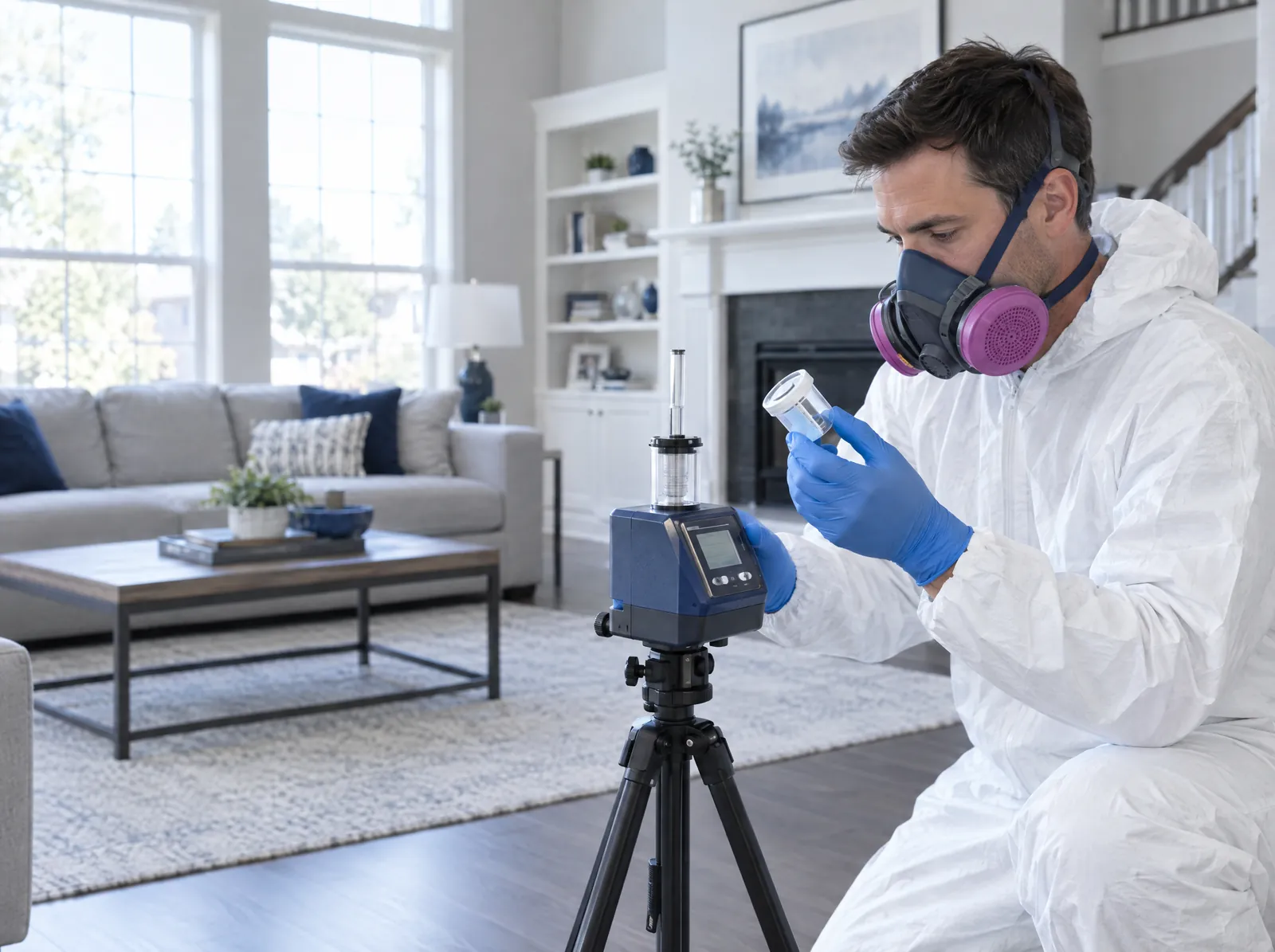
Air samples are usually collected on a spore trap cassette and counted under a microscope. Lab formats differ, but most reports include the same fields for each sample.
- Raw count. The number of spores of each type the analyst actually counted on the slide.
- Count per cubic meter. The raw count scaled up by the volume of air pulled through the cassette. This is the number people usually mean by “spore count.”
- Percent of total. How much of the sample each mold type makes up. Useful for comparing the mix indoors with the mix outdoors.
- Limit of detection. The smallest amount the method can reliably report for that sample. A result below it isn’t the same as zero.
- Background debris. A rating of how much dust and other particles were on the slide. Heavy debris can hide spores, so a high rating makes low counts less certain.
- Hyphal fragments. Pieces of the thread-like body of mold, rather than spores. They can point to active or disturbed growth.
The comparison that gives the number meaning
There are no federal limits for mold in indoor air, so no count on its own means “safe” or “unsafe.” What the report can show is whether the inside of the house looks like the outside, or like something is growing indoors. These are the patterns an inspector looks for.
| Pattern in the results | What it usually suggests |
|---|---|
| Indoor counts similar to or lower than outdoor, with a similar mix of types | Mold indoors is mostly coming from outside, which is normal |
| Indoor counts well above outdoor | A possible indoor source |
| One type dominates indoors but is minor outdoors | Something may be growing inside, even if the total looks modest |
| One room much higher than the others | The source is likely in or near that room |
| Water-damage indicator molds indoors, even in small numbers | Worth investigating for long-term moisture |
Why the type of mold can matter more than the total
Outdoor air in the Midwest is often dominated by molds like Cladosporium and Alternaria, which grow on leaves and soil. Seeing them indoors in similar proportions isn’t surprising. Aspergillus and Penicillium are common everywhere too, but they also grow readily on damp building materials. Their spores look almost identical under a microscope, so labs usually report them together as one group. When that group makes up much more of the indoor sample than the outdoor one, it’s a flag.
Some molds carry more weight even at low numbers. Stachybotrys and Chaetomium need materials that stayed wet for a long time, and their spores don’t stay airborne easily. A few of them in an indoor sample can mean more than a large count of an outdoor mold.
What a spore count can’t tell you
An air sample captures a few minutes of air on one day. Weather, open doors, vacuuming and the HVAC cycle all move the numbers. A normal result doesn’t rule out growth sealed inside a wall, and a single high reading can come from a disturbance during the visit. Spore counts also say nothing about mycotoxins, which need a separate test, or about whether a specific person will react to what’s in the air.
That’s why air sampling works best as one part of an inspection, alongside moisture readings and, when the history matters, dust testing. Our page on indoor air quality testing explains how we set up samples, and the answer on what a good ERMI score is covers the dust side.
We test and remediate buildings. We don’t diagnose or treat medical conditions, and a home test result isn’t a medical diagnosis. If you have symptoms, please work with a doctor. With your permission, we’re glad to share test results with them.
We're done when the lab says so.
Every remediation ends with clearance testing, and our work is backed by a complete-removal guarantee. We don't close a job on a failed result.
Talk to a specialistHave a report you can't make sense of?
Send us the lab report and tell us why the home was tested. We'll walk you through what the numbers show and what, if anything, to do next.
- (833) 772-6653
- info@americanmoldexperts.com
- Open 7 days, 8am to 8pm